
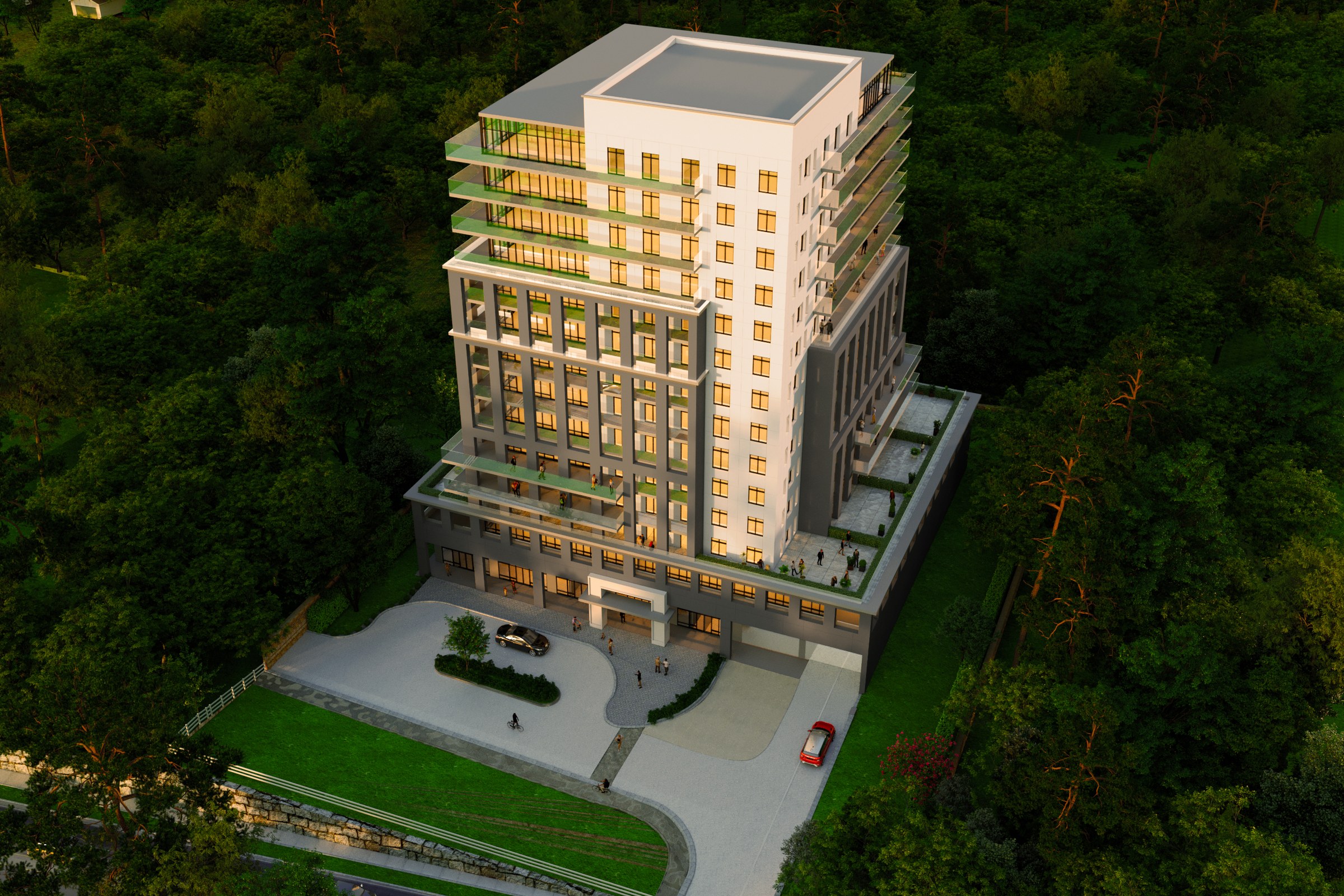
- Hour
- Late, sun low
- Sky
- Clear
- Season
- Full leaf
- People
- A few
The whole packet is one afternoon
Ten images, one moment. Every render sets four coordinates whether you choose them or not — and a board is often asking about the ones you left on their defaults.
Try this on your last submittal. Lay the views out side by side and, under each one, write the hour of day, the sky, the month and roughly how many people are in it.
Almost every set we are ever sent gives the same four answers. Early afternoon. Clear. Some indeterminate summer. A polite scatter of people, never a crowd. Ten images, ten different angles — and, in the sense that matters to a reviewer, one moment, photographed from ten positions. The building has been shown once. The set has simply been thorough about where it stood while doing it.
Nobody decided this. High clear midday sun is the flattering condition, it is the default in every piece of software that renders a sky, and it is the condition a client instinctively approves. It arrives by consensus and it goes unquestioned. But a board is not assessing whether your building is attractive at two in the afternoon in July. It is assessing shadows on a neighbour, light on a street after dark, screening that has to work in winter, and a parking court on its worst evening. Four questions about conditions — and if the packet only contains one condition, the only sentence available for all four of them is the one everybody has heard: we’d like to see a bit more detail.
If that request has felt heavier lately — a fair number of firms tell us it has, and we would not pretend to have measured it — it is worth checking the clock on your own set before you go and render harder. Resolution is the expensive answer to a question about timing.
Every render is stamped, whether or not you set it
A photograph carries its exposure data. A render carries the same four facts and hides them — so we have put them on every image below. Read a packet this way once and you cannot unsee it.
Where the sun sits. Decides every shadow in the frame, including the ones that leave your site.
Clear or flat. Decides whether the light is doing the design’s job for it.
What the planting is doing. Decides whether your screening exists in the image or only in the drawing.
How busy the place is. Decides whether the circulation is being tested or merely described.
What each hour proves, and what it quietly refuses to
Six real views under six genuinely different conditions. Not a house style — a demonstration that each setting answers something the others physically cannot.
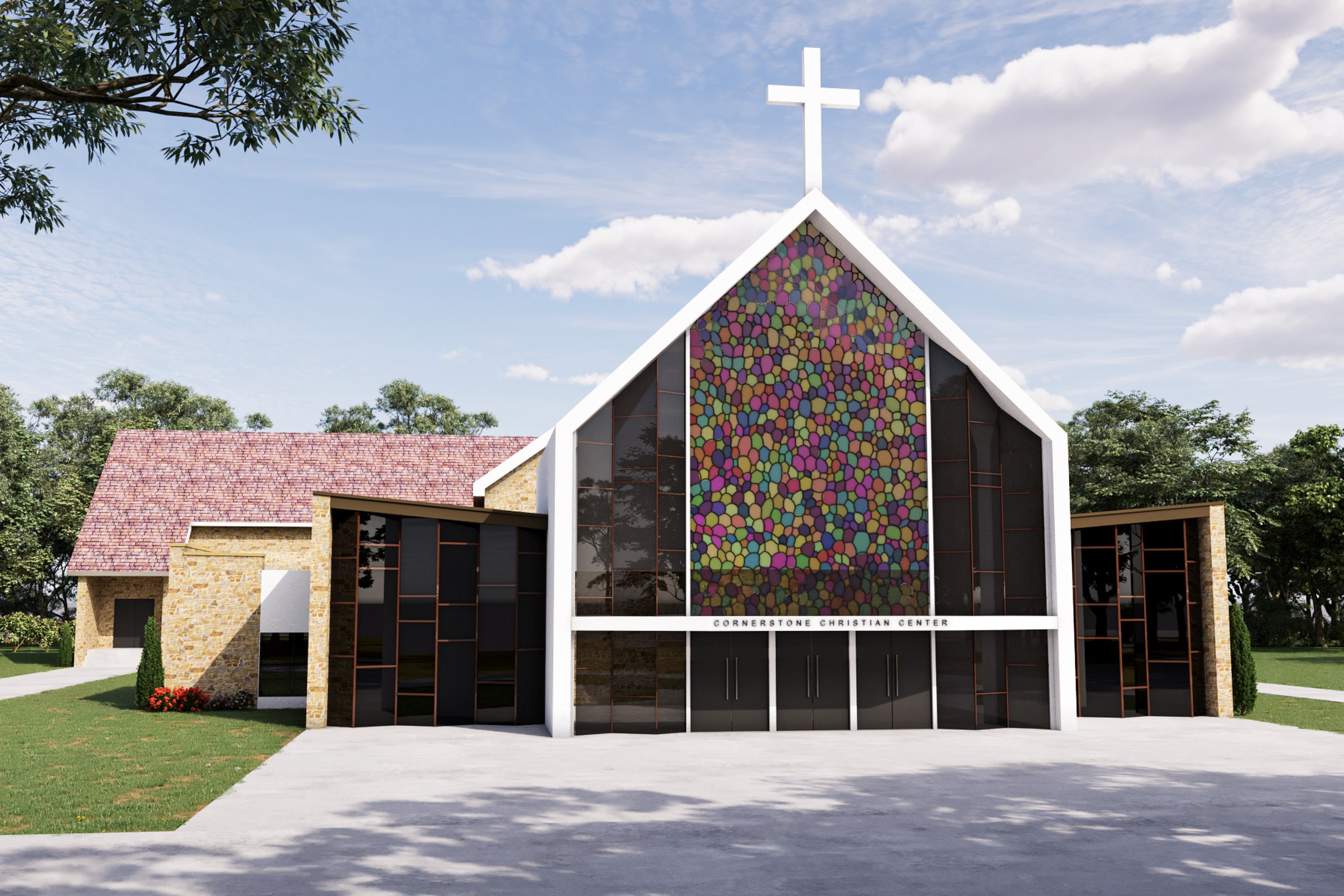
- Hour
- ≈ midday
- Sky
- Clear
- Season
- Summer
- People
- None
The hour nobody chose
High sun, blue sky, short shadows. It is the most flattering light a building will ever get — and it is also the setting the software was already on.
Start by admitting what this hour is for. Sun almost overhead, a few decorative clouds, shadows tucked in tight under the eaves, every surface reading its true colour: this is the condition that makes a scheme look resolved, and there is nothing dishonest about wanting your work to look resolved. The frame below is a good one — a gabled worship building presented square on, stone and white render both reading cleanly, the coloured glazing doing exactly what it was designed to do. What it does not do is answer a single question that depends on the sun being anywhere else, which is most of the questions a reviewer is obliged to ask. And here is the part worth sitting with: almost nobody actively selects this hour. It is where the sun sits when you open a new scene. A default is not a decision, but a board reads it as one.
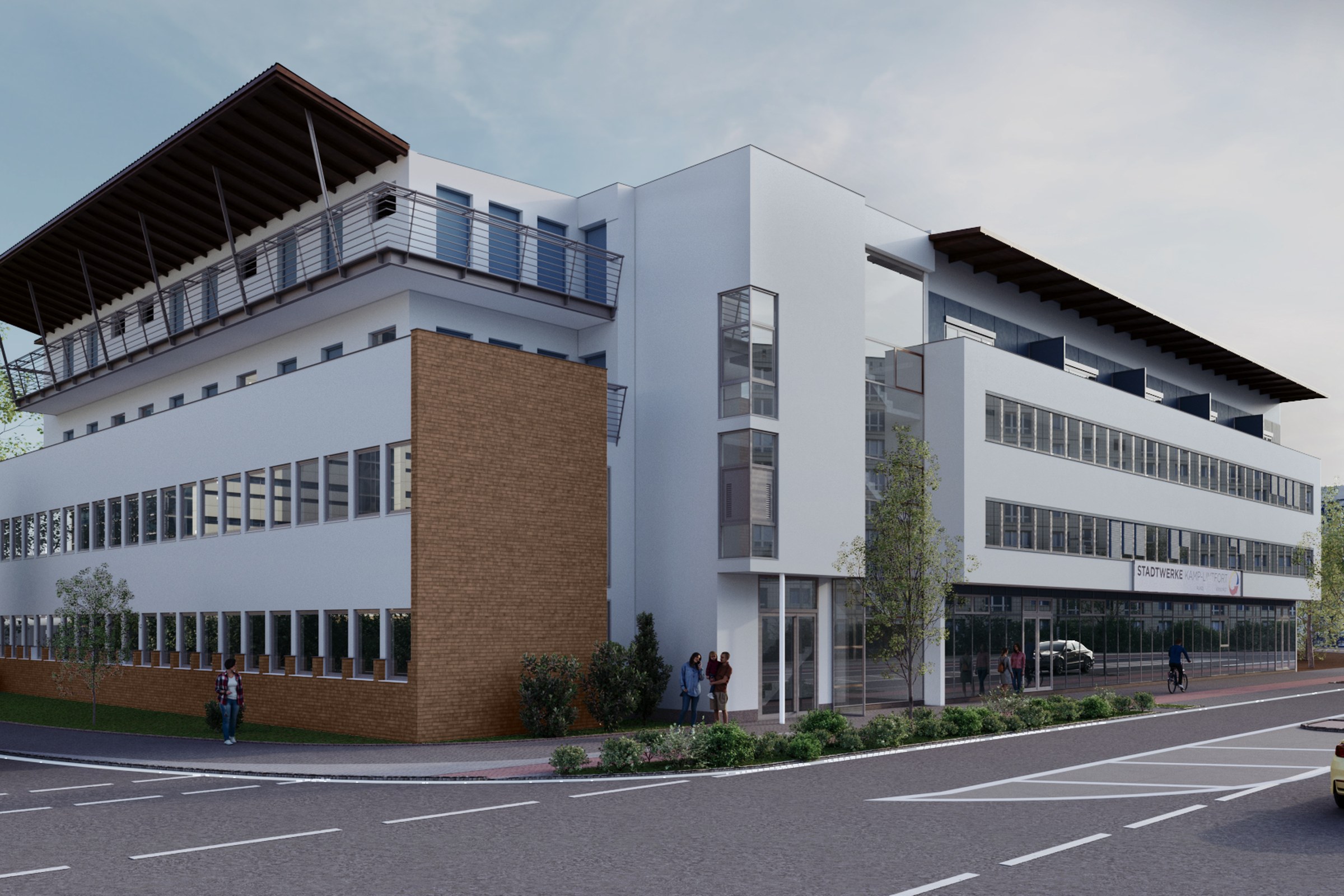
- Hour
- Any
- Sky
- Overcast
- Season
- Shoulder
- People
- A few
What the building looks like when the sun isn’t helping
Across much of the US, a great many days look like this one. Almost no submitted render does.
Take the sun away and a render stops flattering and starts testing. Under a flat sky there is no raking light to carve the massing for you, no warm cast to unify a mixed palette, no long shadow to give a plain elevation a bit of drama. What is left is shape, proportion and tone — the building’s own modelling rather than the sun’s. The frame below is that test: a white office block with a deep timber-soffited overhang, a brick volume anchoring the corner, ribbon windows banding the upper floors, and nothing at all in the sky doing it any favours. It still holds, and it holds for structural reasons — the overhang casts a soft edge of its own, the brick gives the corner weight, the window bands set a rhythm. That is the useful thing about a flat-light view: if the scheme survives it, you have evidence the design is doing the work. If it doesn’t, better you found out before the room did.
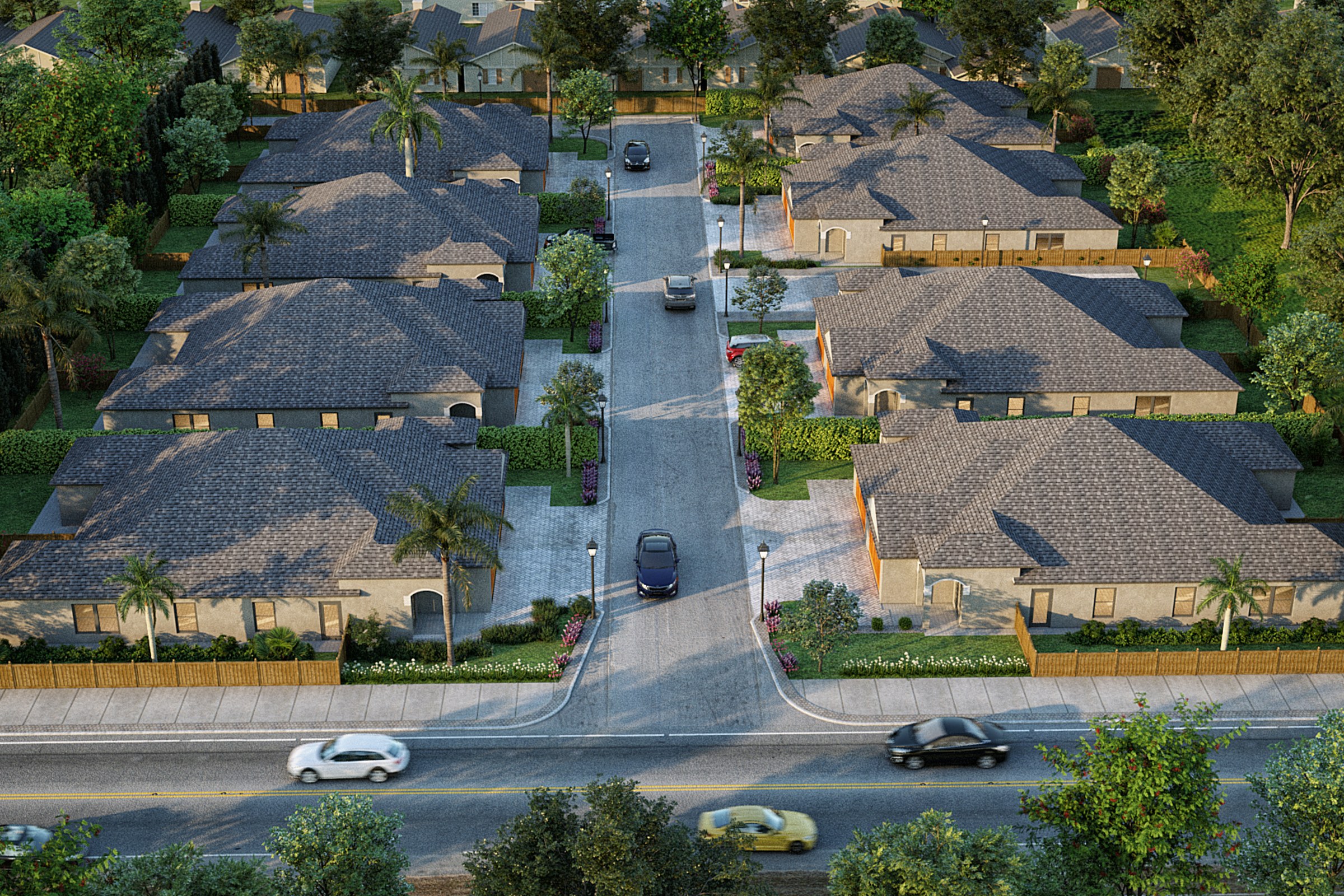
- Hour
- Early / late
- Sky
- Clear
- Season
- Summer
- People
- Passing
The only shadow that belongs to somebody else
Shadow reach is the neighbour’s question. Midday is the shortest shadow of the day — the answer that flatters you most.
Overshadowing sits somewhere in most review processes, and for good reason: it is the one consequence of your building that lands on land you do not own. A shadow at noon falls almost straight down and stays politely inside the site. Drop the sun toward the horizon and it walks — across the sidewalk, across the road, into somebody’s back garden and up the side of their house. Nothing about the design changed; only the hour did. The frame below shows the effect plainly. Late sun rakes across a residential block and the roof shadows stretch clear over the internal street, a fence line lays a long bar of shade across the paving, and the whole geometry of who-shades-what becomes readable at a glance. You do not need a technical shadow study to start this conversation. One extra view with the sun low tells a reviewer that you have thought about the boundary — which is often the actual content of the request.
- Hour
- After sunset
- Sky
- Clear
- Season
- Summer
- People
- Indoors
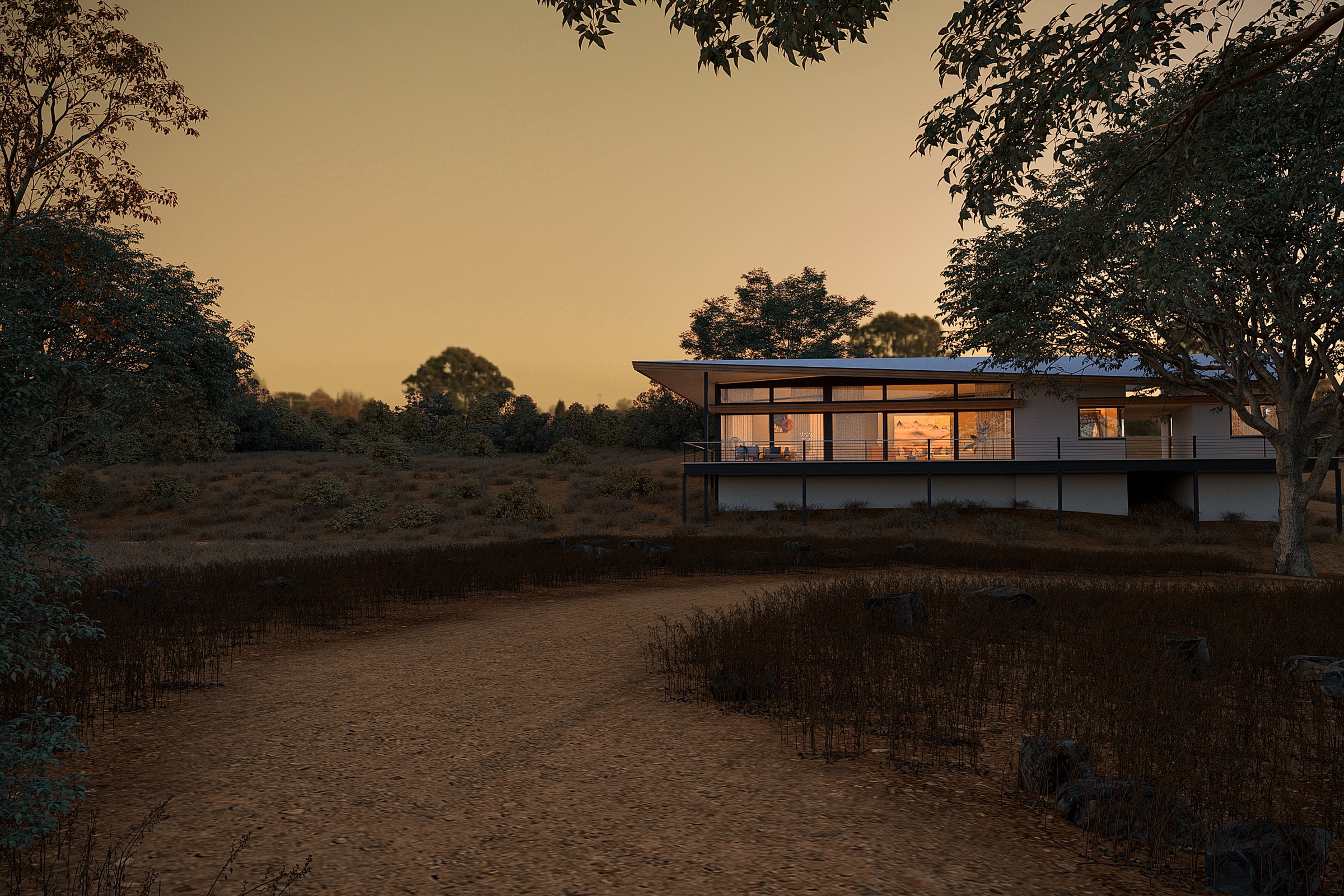
A window by day is a lantern by night
Everything you glazed for daylight broadcasts back out after sunset. Light and spill standards are common in US codes — and this is the view that answers them.
The after-dark render has a reputation as the seductive one, and it is: warm interiors, a sky going amber, a building that finally looks lived in. It is also, quietly, the most revealing image in a packet. It shows exactly how much light leaves the building and where it goes — how bright the glazing reads from the boundary, whether a canopy contains the spill or throws it outward, what the parking court does to a residential edge, whether the roof soffit becomes a strip of glare from the road. Lighting and light-spill provisions turn up in a lot of US codes, and the truthful answer to them is a picture, not a paragraph. The frame below is that picture at its most honest: the glazed pavilion’s interior reading as a single warm band against a dark landscape, and every question about how much of that reaches the ground answerable by looking. It costs one more pass over a model you already built.
- Hour
- Mid-morning
- Sky
- Clear
- Season
- Spring — in flower
- People
- A handful
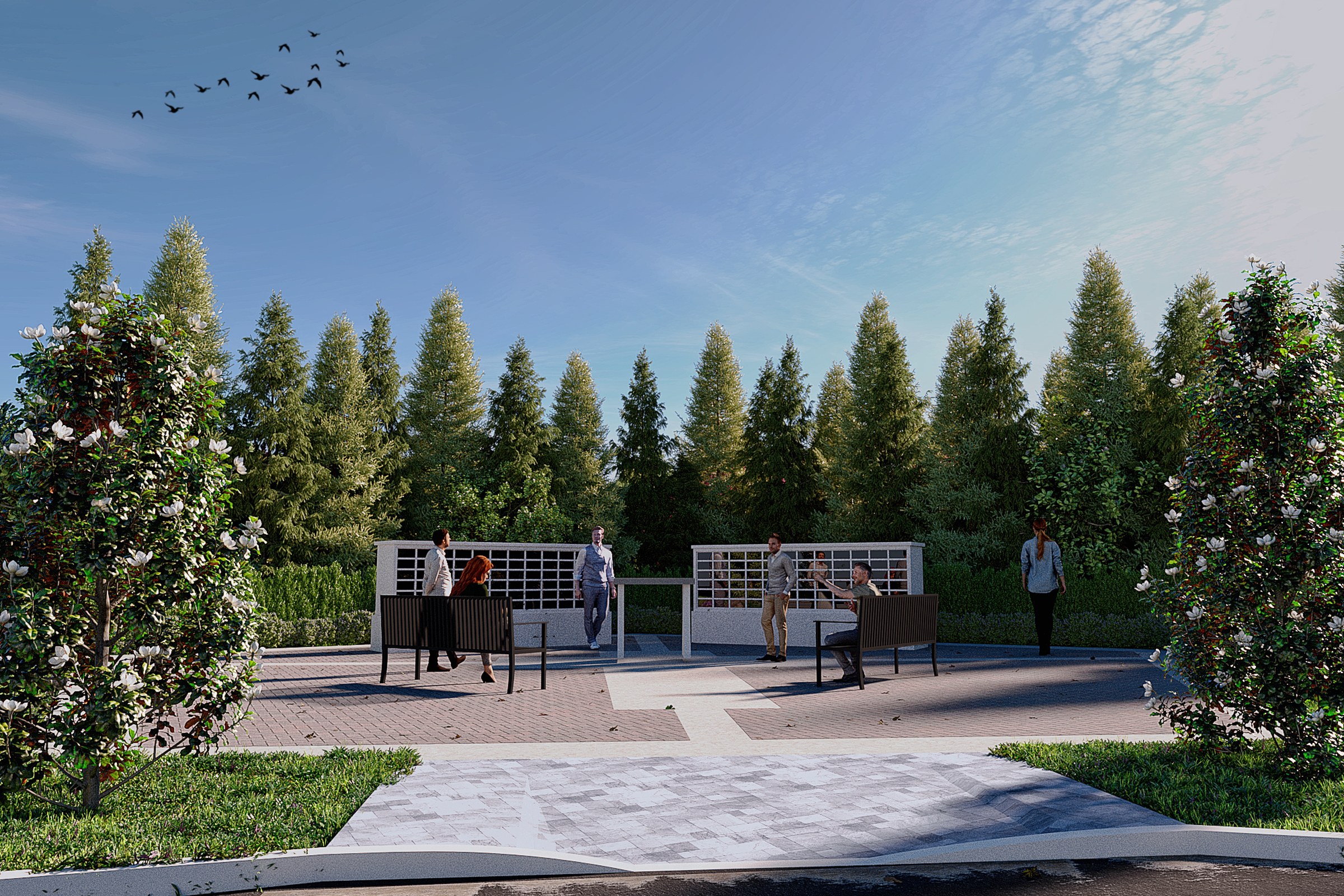
Every render is set in one week of the year
If the thing screening your scheme drops its leaves, it screens nothing for about half the time anyone will see it.
Look at the planting in your last packet and ask what month it is. Renders are almost always set in the good weeks: full canopy, grass at its greenest, something in bloom. That is fine as an image and awkward as an argument, because planting is frequently doing real work in a submittal — softening a flank, screening a service area, breaking up a car park, holding an edge against a neighbour. A deciduous screen holds that line for part of the year and is a row of sticks for the rest of it, and a reviewer who has seen this before will ask. The frame below happens to be the honest version: a memorial garden backed by a dense evergreen screen that genuinely will hold, with magnolias in full flower in the foreground telling you exactly which few weeks the view is set in. Both facts are visible in one image. Knowing which of your greenery is which — and saying so — is worth more than another render at any resolution.
- Hour
- Mid-afternoon
- Sky
- Clear
- Season
- Summer
- People
- Almost none
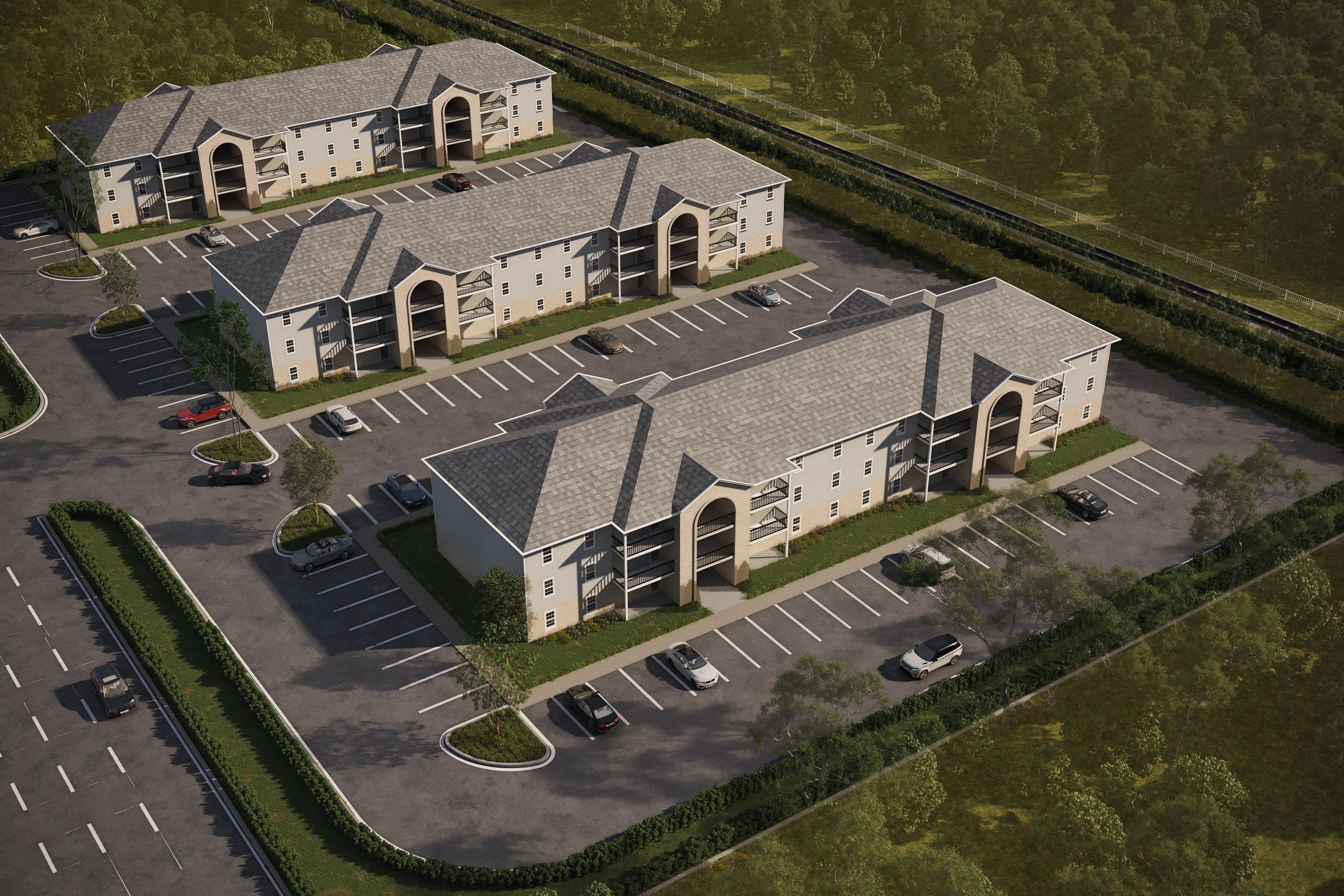
Every parking question is a question about twenty minutes
Traffic, loading, drop-off, overflow: all of it is about the busiest moment of the day. Renders are almost always set in a quiet one.
This is the coordinate people forget is a coordinate at all. A render is not just an hour and a sky — it is an attendance. Populate a scheme lightly and it reads calm, generous, easy to move through; populate it at peak and the same geometry reads differently, because the questions a reviewer has about circulation are questions about the worst twenty minutes, not the average one. School pick-up. Sunday service letting out. The Saturday of a retail centre. Shift change at a clinic. The frame below is a completely normal, entirely competent render of a three-building residential scheme, and its lot is nearly empty — bays striped, aisles clear, a dozen cars in a field of a hundred spaces. Nothing about that is wrong. It simply cannot answer the question a reviewer actually holds, which is what this place looks like on the evening everybody is home. One populated view retires an entire strand of that conversation.
A render is a timestamp you didn’t know you were setting — and a board is reading it.
Count how many conditions your last packet answered
Not how many images it had. How many conditions. Tick the ones that genuinely appear somewhere in the set.
- 01 The default hour Clear sky, sun high. You have this one.
- 02 The flat hour Overcast. Does the massing still work?
- 03 The low hour Sun low. Where does the shadow land?
- 04 After dark What the building gives back to the street.
- 05 The other season What the screening does in January.
- 06 The busy hour The place at its worst twenty minutes.
In our experience most sets come back with one. Occasionally two, when somebody wanted a dusk shot for the brochure and it happened to also be useful.
The repair is close to free, and this is the part worth knowing: none of these are new renders in the sense that costs money. The model exists. The materials exist. The camera does not even have to move. Changing the hour, the sky, the season or the crowd is a lighting and population pass over work that is already done — which is why, if you only add two, we would always suggest the low hour and after dark. One is the neighbour’s question. The other is the code’s. Between them they retire most of what gets called more detail.
Four neighbours to this one, if your question is a different one: which exhibits belong in the packet at all, why the request lands where it lands, how far apart your views are standing, and what happens to your images after the packet leaves your desk.


