
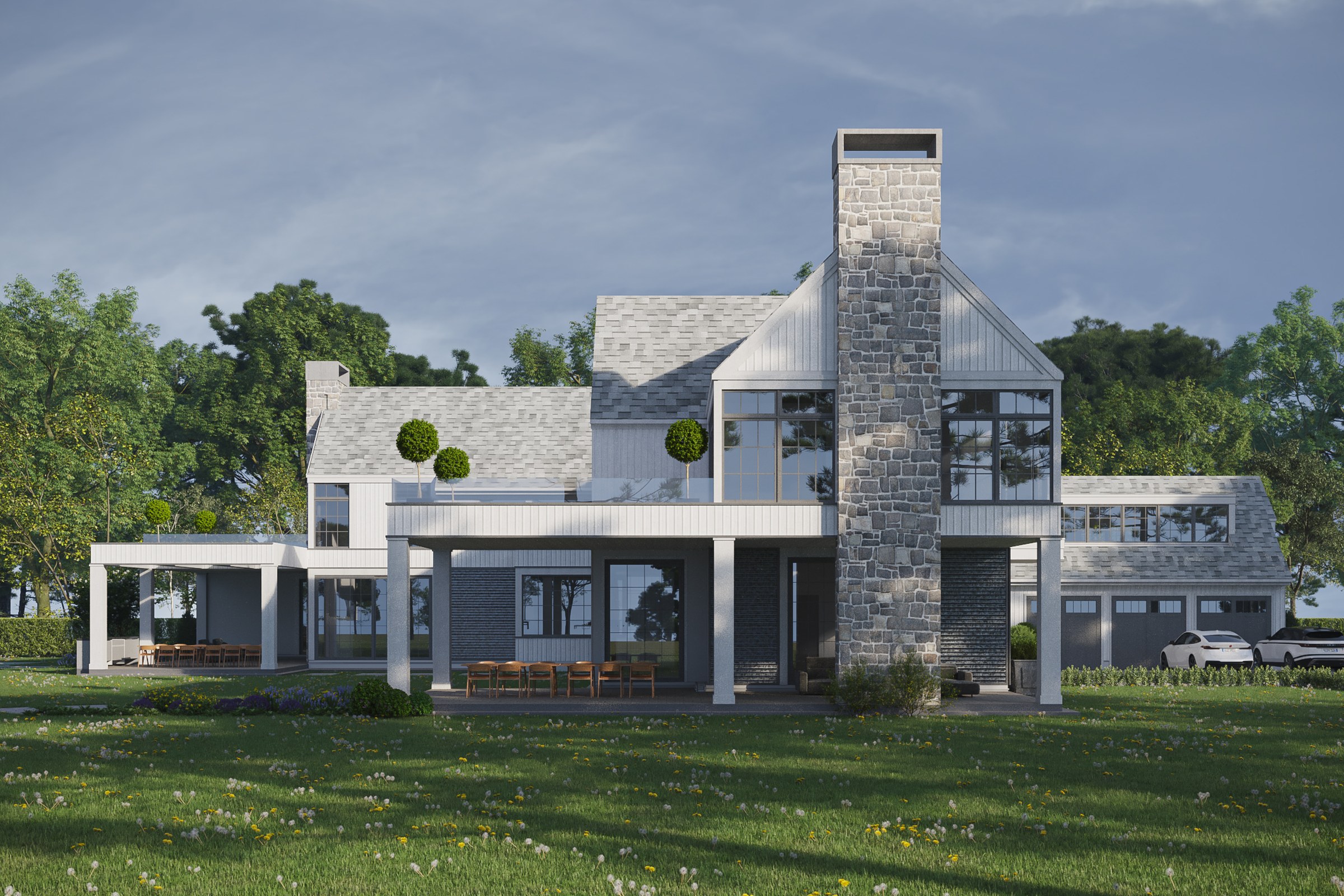
The price of a revision is mostly its date
An ask is not big or small. It is early or late — and the ladder that decides which is invisible from outside the studio, which is exactly how a reasonable question turns into a fight.
Every part of the image above looks equally editable. That is the illusion, and it is a very good one.
A finished render presents as a photograph, and a photograph implies a world that already exists — so of course you could move that, warm that, take it from over there instead. But the frame was not photographed. It was assembled, in an order, and each stage took the one before it as an input: the light was balanced for a fixed geometry, the materials were judged under that light, the planting and people were placed where that camera could see them, and the final hours of machine time were spent resolving all of it at once. The order is not a house style. It is a dependency chain, and a dependency chain runs one way.
Which means a revision has no size of its own. Could we see it from the garden side? is eight words. Said on the first afternoon it costs the price of saying it. Said in the last week it is most of the job a second time. Meanwhile could the planting be less green sounds like a real aesthetic intervention and is twenty minutes at any point in the calendar, forever. Nobody outside a production pipeline can tell those two apart, because from where you are standing they are both just sentences about a picture.
An ask is not big or small. It is early or late.
Here is the failure that produces, and it is the one this page actually exists to prevent. An architect asks for something entirely reasonable. There is a pause on the other end, or a carefully-worded email about scope. And the pause gets read — fairly, given the available evidence — as a studio being precious about its own work, or protecting a margin, or simply not that interested in getting the scheme right. It is almost never any of those. It is a ratchet with a shape. But an invisible constraint always looks like an attitude, and that is how two people who agree about the building end up in a fight about the building.
So: the ladder, plainly. Six rungs, in the order they close, with what each one costs while it is open and what it costs once the rungs above it have latched. None of this is an argument for asking less — it is the opposite. The expensive rungs are the ones carrying your design intent, and you want to be spending your questions up there while they are still free.
Six rungs, and what each one quietly closes behind it
Read the gold rail under each plate first: the segments already latched are the ones you can no longer change without paying for everything to their right. The two cells underneath are the same sentence, priced on two different days.
- Model
- Camera
- Light
- Surface
- Dressing
- Resolve
Latches behind it — Every camera position that has been chosen since, and every frame in the set that already saw this element.
Nothing. At this rung the building is still an argument, and arguments are free to change.
Everything downstream. The light was balanced for these planes, the materials were tuned under that light, the entourage was placed where this camera could see it. Move the geometry and you have not edited an image — you have asked for the image again.
The cheapest hour of the whole job is the one where the building is still soft
And it is the hour in which nobody feels any urgency at all.
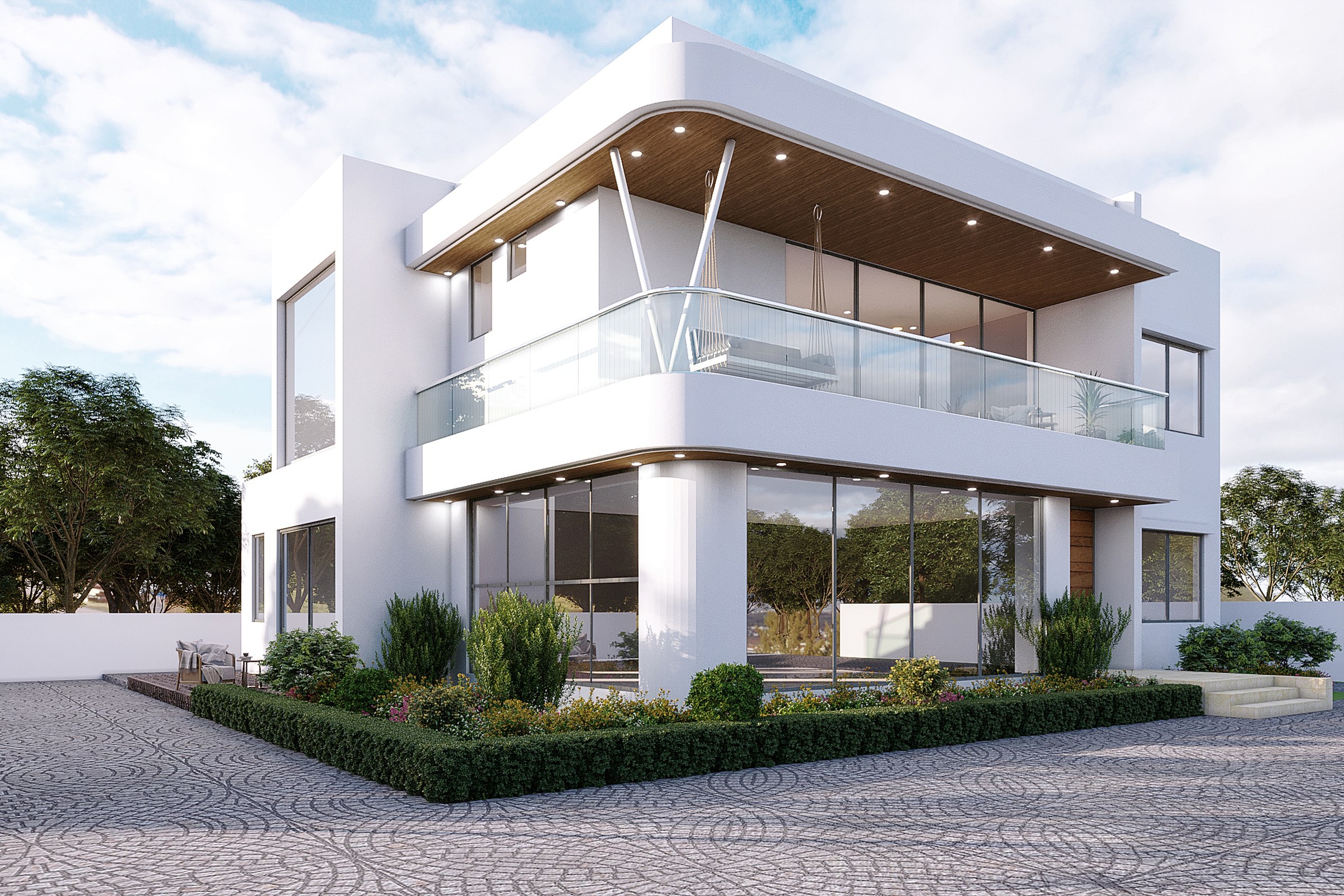
This villa is doing what a scheme does at the start: it is almost entirely form. A stack of volumes, a corner turned, a soffit held out over a terrace — decisions that live in the model and touch every single thing that comes after. At this rung the eight most expensive words in archviz, could we lose a storey and stretch it, cost the price of typing them. Three rungs later the identical sentence means the light rig is rebuilt, the material tuning is re-judged, the placed people and planting no longer sit where they were placed, and every other frame in the set that showed the old massing now quietly disagrees with this one. The sentence never changed. The date did. This is the whole thesis of the page and it is the last time it will be this obvious.
- Model
- Camera
- Light
- Surface
- Dressing
- Resolve
Latches behind it — The lighting setup, and the position of every object placed to be seen from here.
Minutes. Before anything is lit, a camera is a number you nudge.
A rebuild wearing a familiar face. Light is balanced for a specific frame, and dressing is placed for a specific frame — a chair angled to be read from here, a plant put exactly where the mullion would otherwise land. Move the camera afterwards and the lighting and the dressing are both wrong in ways nobody can name, only feel.
A viewpoint is not a preference. It is a foundation.
Half of what a frame contains was put there for that frame.
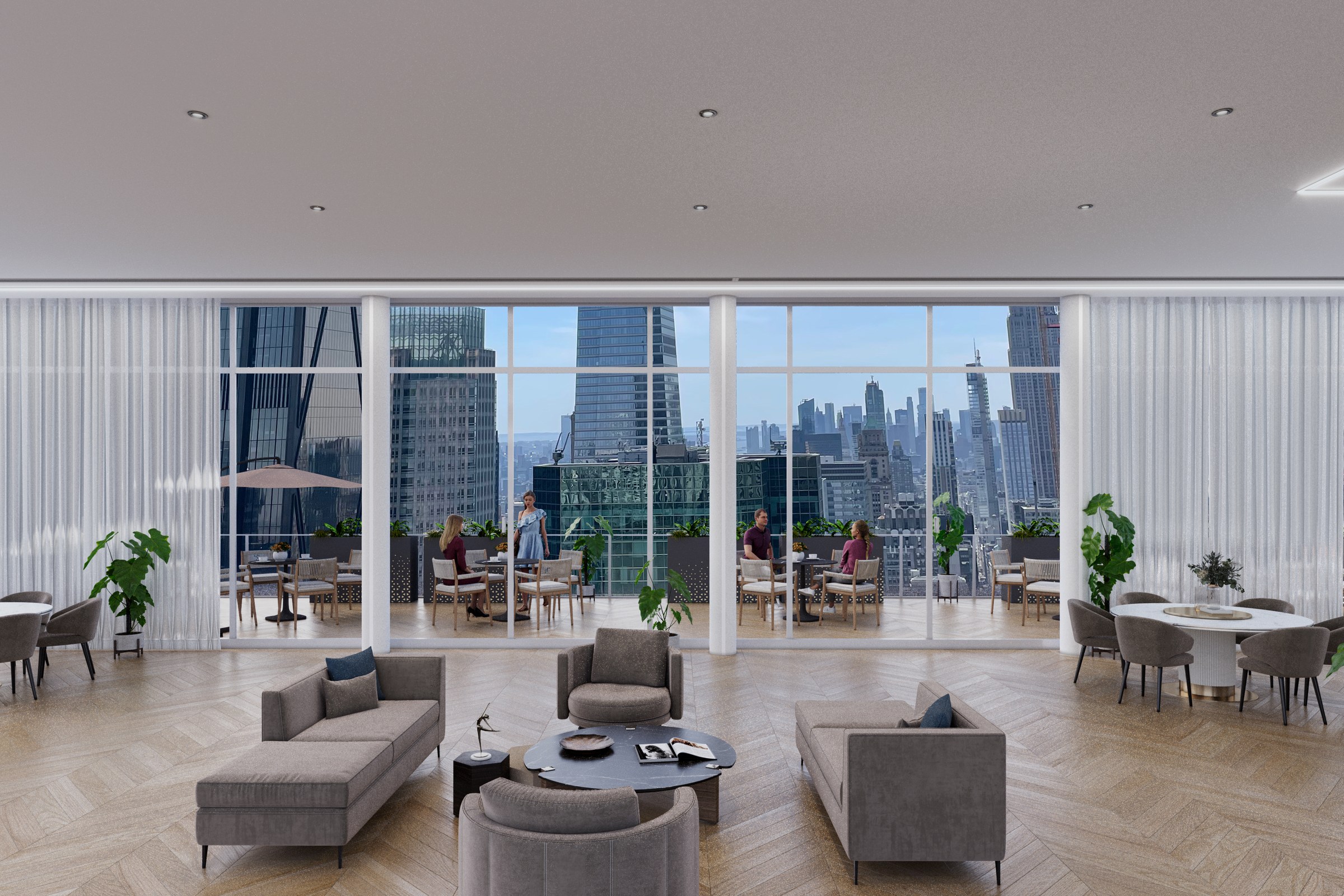
Look at what this room owes to standing exactly here. The glazing is centred, so the skyline reads as a held picture rather than a corner glimpse; the sofas are turned to leave the middle open; the terrace tables are visible through the glass because they were positioned to be visible through the glass. None of that is fakery — it is what composing an image means. But it does mean the frame is not a window you can slide along a wall. Ask on the first afternoon to see this from the corner instead and it is a nudge. Ask once the room has been lit and dressed and you are not asking for a different angle, you are asking for a different picture with the same furniture in the van. Worth knowing, because a viewpoint is also one of the things practices most often want to reconsider once they have seen anything at all.
- Model
- Camera
- Light
- Surface
- Dressing
- Resolve
Latches behind it — Every material decision made after it, because each one was approved under this sun.
An afternoon, and a genuinely enjoyable one.
The material stage again. Every surface in the frame was judged under this light — a timber read warm because the sun was low and orange, a stone read soft because the shadow was long. Change the hour and none of those readings hold; the palette has to be re-judged from scratch under a light nobody has seen it in.
You are never approving a material. You are approving a material at an hour.
Which is why the palette conversation cannot start until the sun has stopped moving.
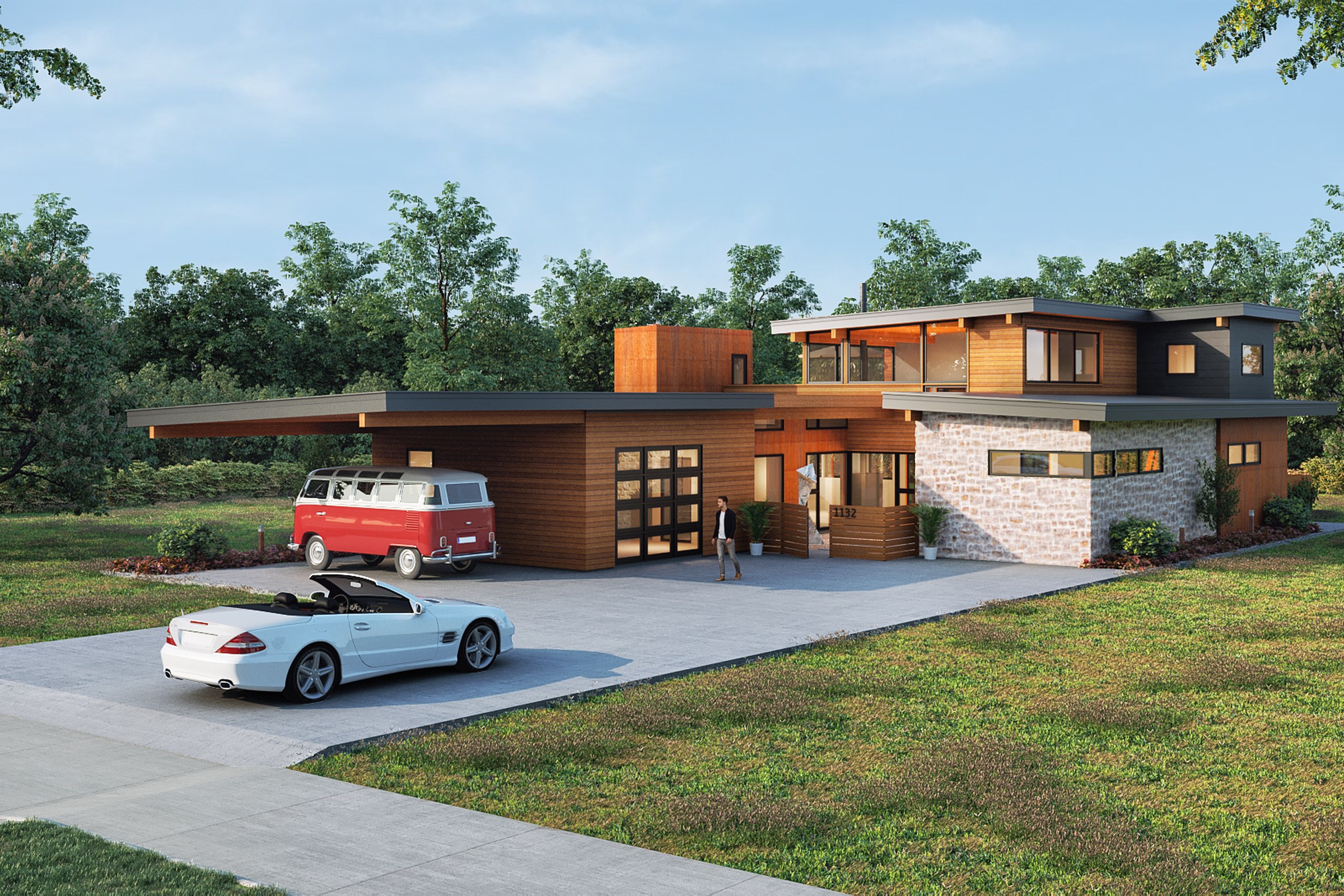
This is a scheme that lives on its light. The overhangs are deep because the sun is low; the timber is glowing because the light is late and warm; the interiors read as inhabited because they were lit at the one hour of the day when lamps and daylight are both true at once. Set that same house at eleven in the morning and everything you can see changes its mind — the cladding cools, the soffit shadow flattens, the glass goes from lit to blank. That is the trap in a very reasonable-sounding note: the timber is a bit orange. Sometimes the timber is a bit orange. Just as often the timber is correct and the hour is doing it, and swapping the timber will produce a second material nobody likes, at a second hour nobody chose. If the hour is still open, say so early; it is the last rung where a big move is still an afternoon.
- Model
- Camera
- Light
- Surface
- Dressing
- Resolve
Latches behind it — Very little. This is where the ratchet finally slackens.
One surface, cheap. The logic underneath the surfaces, not cheap.
Almost the same, which makes this the friendliest rung on the ladder — and the most misleading one, because it teaches everybody that changes are small.
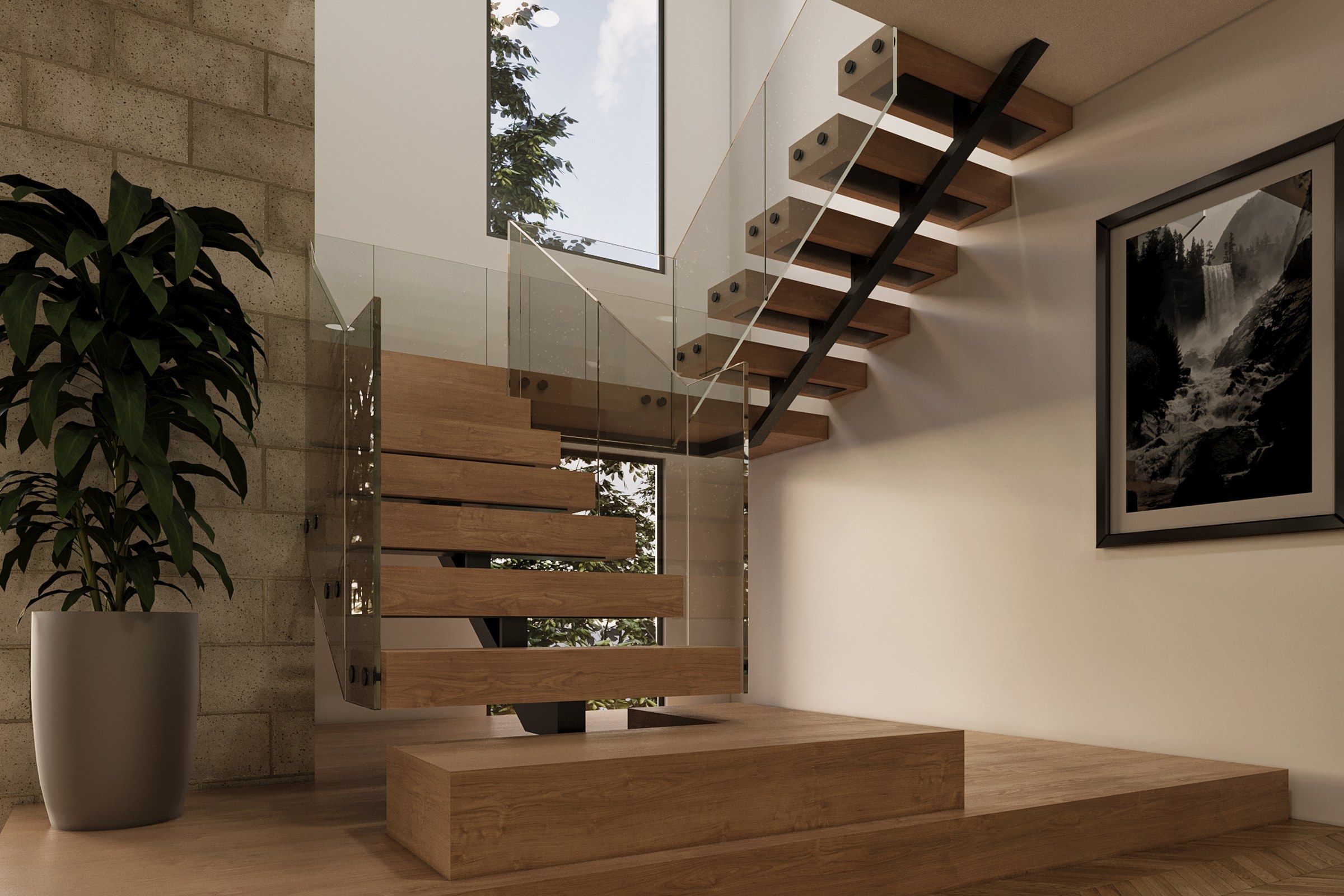
Swapping a material is small. Swapping the reason for the materials is not.
And from outside, those two asks are written in exactly the same words.
Four surfaces are meeting in this frame and each one is carrying an argument: rough blockwork to make the wall feel structural, oak to make the treads feel warm and thick, glass to make the balustrade disappear, black steel to make the spine read as the only thing doing work. Could the treads be darker is a genuinely small ask — one material, one re-render, no consequences. Could it feel less rustic is a different animal in a similar coat: it is a request to re-argue the relationship between all four, and re-argue it under a light that was fixed at the rung above. Neither ask is unreasonable. But a studio that hears the second and quotes you the first will hand back something that answers neither, and now you are two rounds in on a misunderstanding that was three words wide. The repair, as ever, is naming which one you meant before anyone opens anything.
- Model
- Camera
- Light
- Surface
- Dressing
- Resolve
Latches behind it — Nothing. Nobody builds on top of a chair.
Cheap.
Also cheap. Genuinely, almost to the end.
The rung everybody spends their questions on — because it is the one that always says yes
It is also, almost by definition, the rung that carries none of your design.
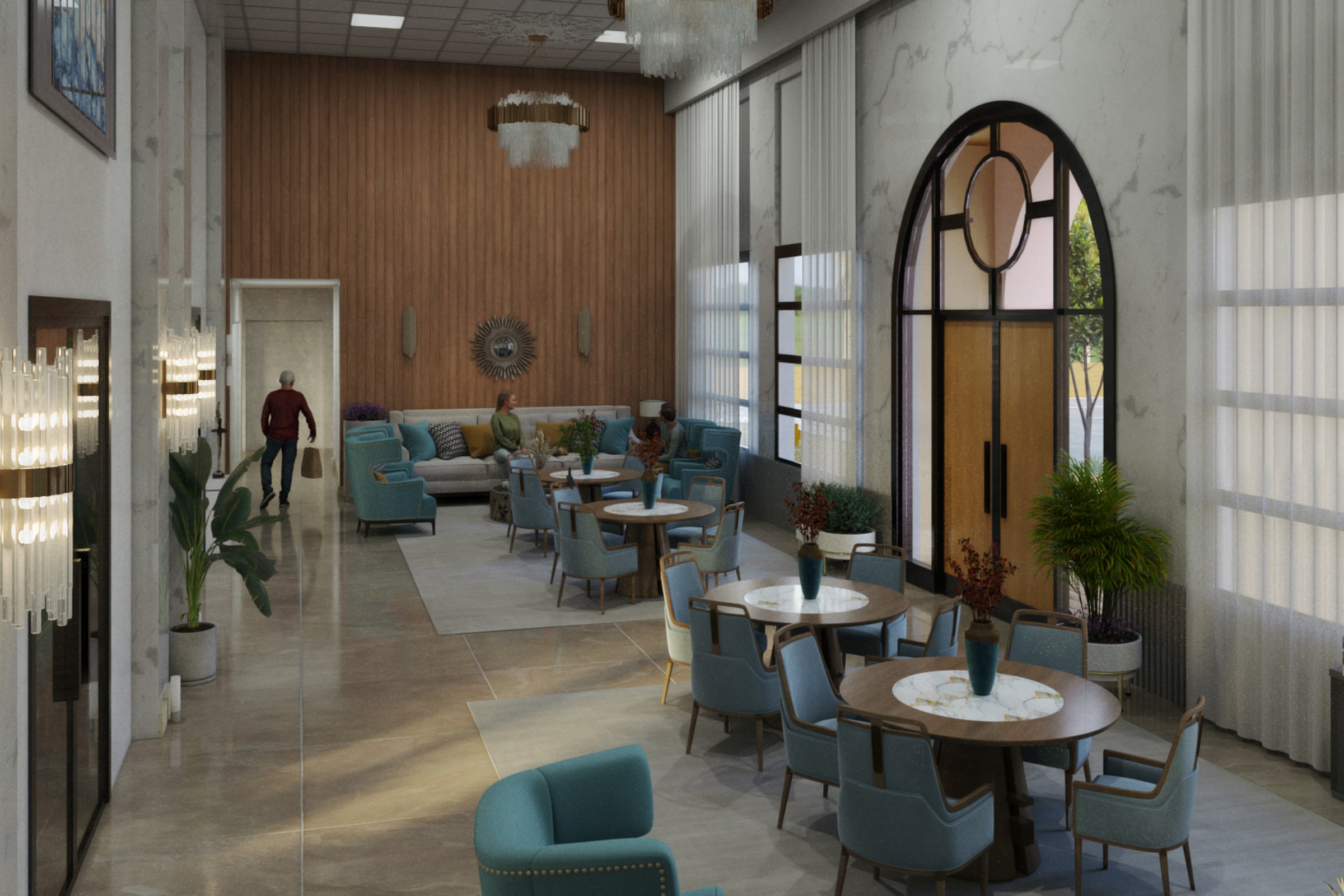
This lounge is dense with the stage of the job that changes most easily: chairs, tables, planting, art, the figure receding down the corridor. All of it can be moved, swapped, thinned or multiplied at practically any point, and every studio on earth will say yes quickly, because saying yes is quick. That responsiveness is lovely and it quietly trains a habit. A practice learns that this is what asking feels like — a note, a nod, a fixed image by tomorrow — and calibrates all its other notes to that experience. So when a bigger question arrives and the answer is a pause, the pause reads as reluctance rather than as arithmetic. Ask for the dressing freely; it costs almost nothing and it is often what makes a frame feel alive. Just do not let it become the shape of the whole conversation, because none of it is your building.
- Model
- Camera
- Light
- Surface
- Dressing
- Resolve
Latches behind it — Nothing after it. There is nothing after it.
Not applicable — this rung only exists at the end.
By design, late. It is the one stage built to be last, and the only one whose cost is machine hours rather than a decision.
The only rung where “small change” is literally true
Everything expensive already happened above this line.
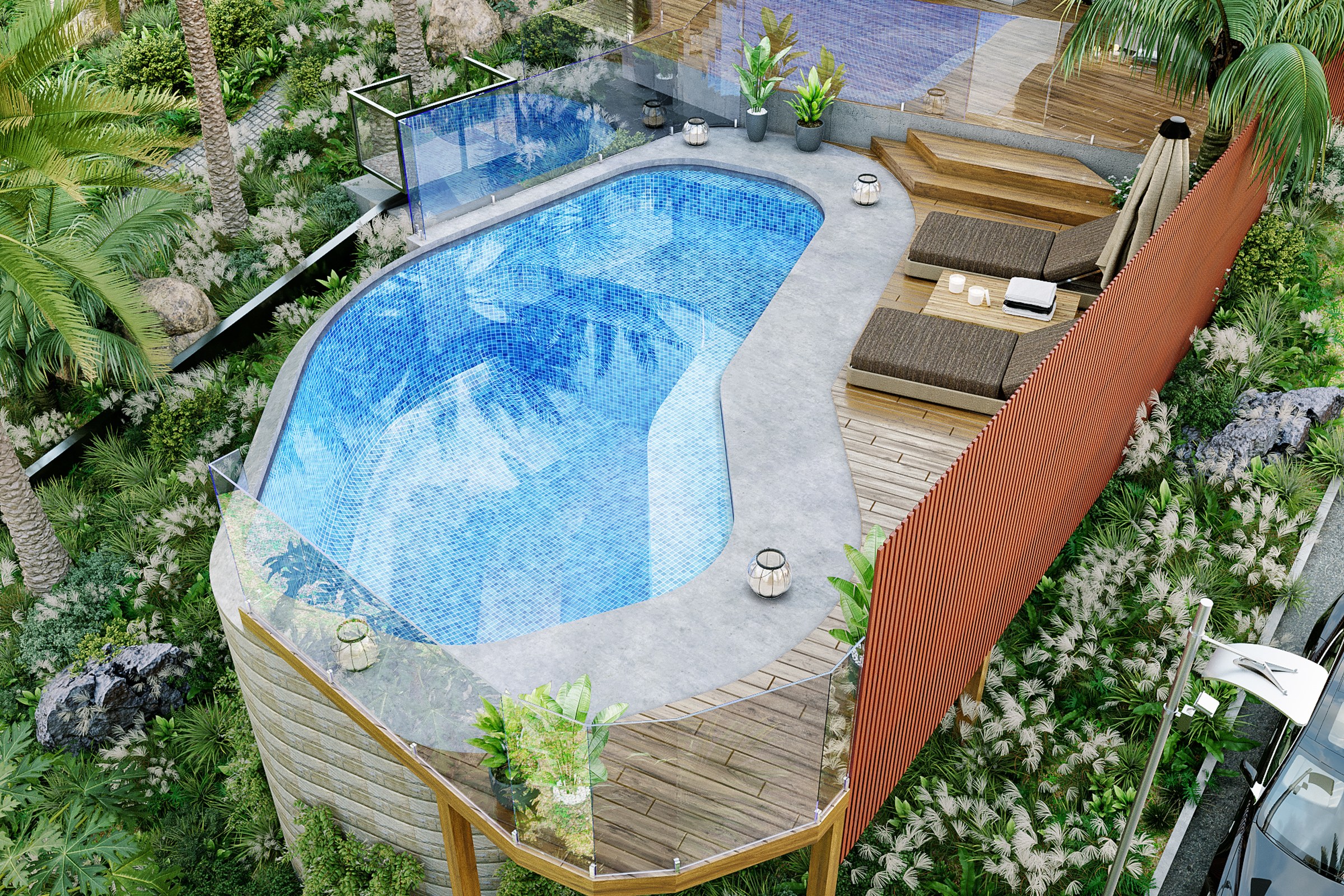
What makes this frame work is almost entirely resolve: caustics moving across mosaic tile, palm shadows breaking on water, glass returning the planting behind it, foliage dense enough to sit still. None of that is a decision — it is time, spent by a machine, on a scene where every decision has already been made. Which is why the last stretch of a job feels so different from the rest: the images are getting visibly better and nobody is being asked anything. It is also why the note that arrives at exactly this moment is the one that hurts. Not because it is wrong — it is usually the best note of the whole job, because the person writing it has finally had enough time in front of the thing to know what actually bothers them. It is just standing at rung six holding a rung one question. Nothing in the pipeline can help with that. Only the calendar can.
Feedback arrives in almost exactly the reverse order of cost
Which is not anyone’s fault, and is the single most useful thing to know about a revision cycle.
Round one is nearly always dressing and colour. Not because the reader is shallow — because those are the notes available after four minutes with an image. Round two gets into materials. And the deep one, the rung-one question — is this even the view of it that matters? — tends to surface at round three, once somebody has lived with the thing long enough to work out what has been bothering them. That note is usually right. It is also, by then, the most expensive sentence in the project.
So the ladder closes from the top down while the conversation opens from the bottom up, and they pass each other somewhere in the middle of week two. Every difficult revision round we have ever been part of, on either side, was that crossing. Not a disagreement about design. A collision between how long thinking takes and how a pipeline is obliged to run.
There is no clever fix, and we would not trust anyone selling one. There is only doing the looking earlier — badly, roughly, on an unfinished frame, out loud with someone who can tell you which rung you are standing on. Twenty minutes of that in week one routinely removes a fortnight of it in week three.
The best note of the job almost always arrives last. That is not carelessness. It is how long it takes to know what is wrong.
Why “that’s a big change now” isn’t a comment on your design
This is the part of the relationship that goes wrong silently, because both sides are being polite about the wrong subject.
- 01
It is a schedule sentence
“That’s a big change now”Almost every time, that sentence is arithmetic about what has to be rebuilt and in what order — not a verdict on the idea and not a defence of the work already done. It just happens to sound identical to both.
- 02
Nobody is incentivised to tell you
Including usA studio billing by revision round has no particular reason to explain which questions get expensive and when. We would rather not have that round at all: it is the one where a practice pays to rebuild something it would have changed for free a fortnight earlier, and nobody enjoys the invoice.
- 03
A revision fight is a price argument
With the word price left outOne side is talking about design and the other is talking about consequence, and because neither says so, it reads as intransigence in both directions. Put the ladder on the table and the temperature drops immediately — there is nothing left to be annoyed about, only a sequence to plan around.
A last-free-moment for every decision you are likely to want back
Steal this. It is more useful in your inbox than on our website, and it works on whoever is rendering for you.
-
Change the massing, the roofline, a storey
FreeUntil a camera is chosen
After thatEvery frame that saw it is made again — and the ones that did not now disagree with the ones that did.
-
Move the camera, or add an angle
FreeUntil the light is set
After thatThe frame is re-lit and re-dressed. It is a new image with a familiar building in it.
-
Change the hour, the sky, the season
FreeUntil materials are tuned
After thatEvery surface was approved under the old sun. All of it is re-judged under a light nobody has seen it in.
-
Re-argue the palette — “less rustic”, “warmer overall”
FreeUntil the material stage starts
After thatIt is the material stage again, at full length, and under a light that is now fixed above it.
-
Swap one material for another
FreeNearly to the end
After thatCheap, but it is still a re-render — so it costs machine time and a slot in the queue, not judgement.
-
Add, remove or move people, cars, planting, furniture
FreeEffectively to the end
After thatStill cheap. Ask freely. Just do not spend your good questions here.
-
Push resolution, regrade, recrop
FreeThis one is meant to be last
After thatThe only rung built for the final afternoon — and the only one where “small” was always true.
These are shapes, not a tariff. Every studio orders its work slightly differently, a small job collapses three rungs into one afternoon, and there is no number anywhere on this page for a reason. But the direction is the same everywhere it is done properly, because it follows what depends on what.
Which is the honest reason a week is worth arguing about. On a job that has not started, every rung on this page is open — and that is the only moment when “actually, could we see it from the garden?” costs nothing at all.
It is also, unhelpfully, the moment at which nobody feels the slightest urgency. Nothing is late, nothing is wrong, and there is no obvious reason to spend twenty minutes talking about a picture that does not exist yet. That is the whole trick of this ladder: it charges you nothing at the start, so you have no reason to look, and it charges you everything at the end, when looking is finally interesting. The only counter we have found is to make the early conversation small enough that it does not need justifying. Two angles. Twenty minutes. Whatever is on your screen today.
Neighbours, if your question is a different one: why two angles beat one for getting a real answer (that page says a call is where you learn what a change costs — this one is the explanation underneath it, of what governs the cost at all), the six questions worth asking before anyone changes anything, the five minutes of brief that stop rung one going wrong, and what happens to a set when one frame is rebuilt and the others are not.


