
What a Mood Board Can't Say Until the Room Is Lit

Your client said yes to the mood board. So why does the first image still feel like a different project?
Because a mood board is a promise of a feeling, and an image is the first test of it. Between the two sit three things a board can’t hold: light, scale and company. Each is where design intent quietly gets lost.
Light is the first thing the board leaves out
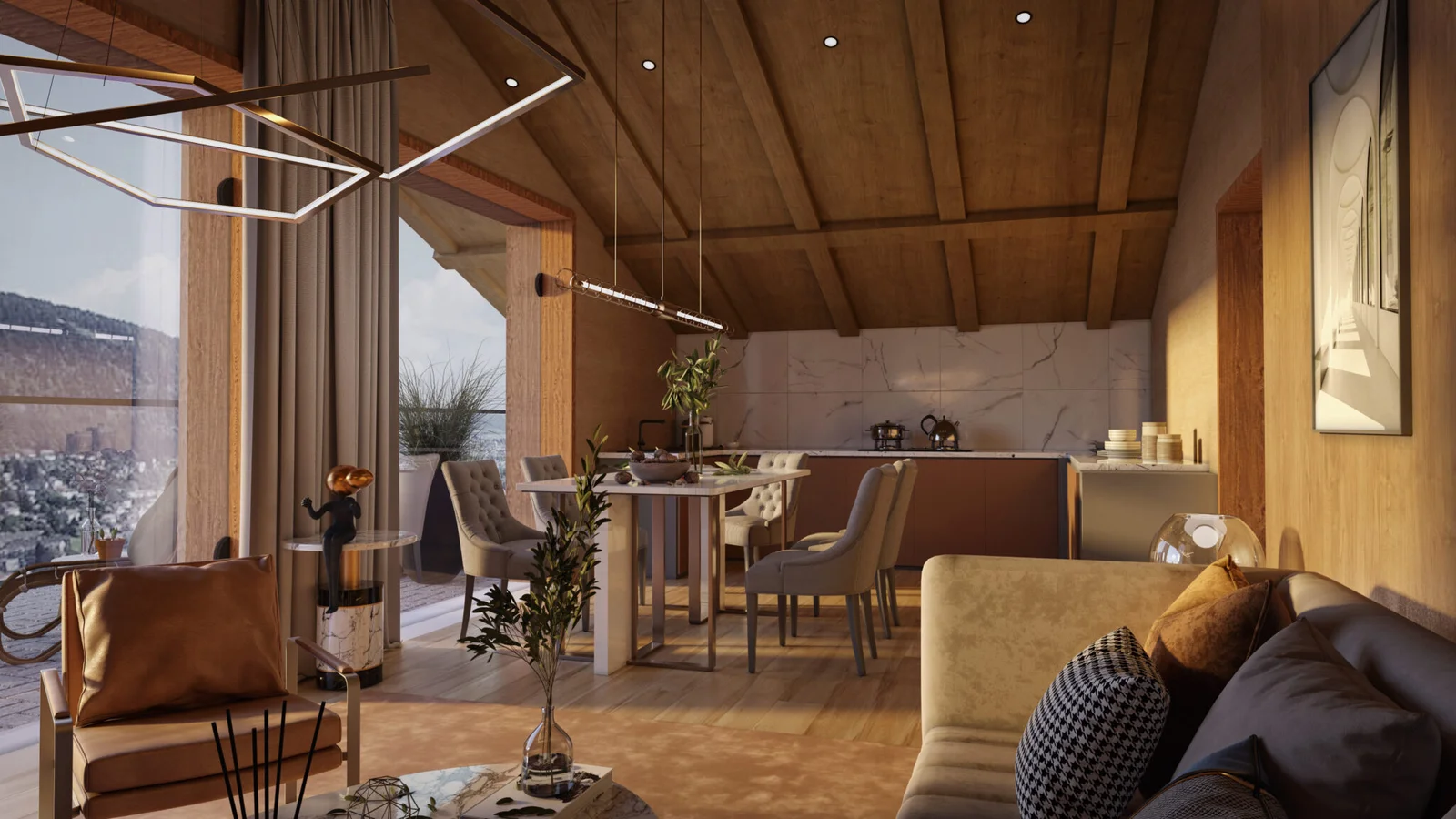
Look at what is doing the work in a room like this. Warm timber above, pale veined stone behind the kitchen, soft upholstery in front. On a board, those are three separate swatches. In a lit view they become one atmosphere, and the atmosphere comes mostly from how light lands on each surface: the glow on the timber, the cooler face of the stone, the shadow under the beams.
Two boards with identical materials can describe two very different rooms depending on where the light is coming from. So the first conversation worth having is not “which finishes?” but “what time of day is this room for?” Morning kitchen, evening lounge and a showroom under daylight all need different answers, and that answer decides how everything else should read.
Scale is the second
A swatch tells you what a finish looks like at the size of a hand. A room asks how it looks at the size of a wall.
A bold stone, a strong tile pattern, a deep colour on cabinetry: all of them behave differently once they cover real area beside real neighbours. That is the moment a first view earns its place. It lets you and your client see the proportion, before anyone has committed to it in a specification or on site.
Company is the third
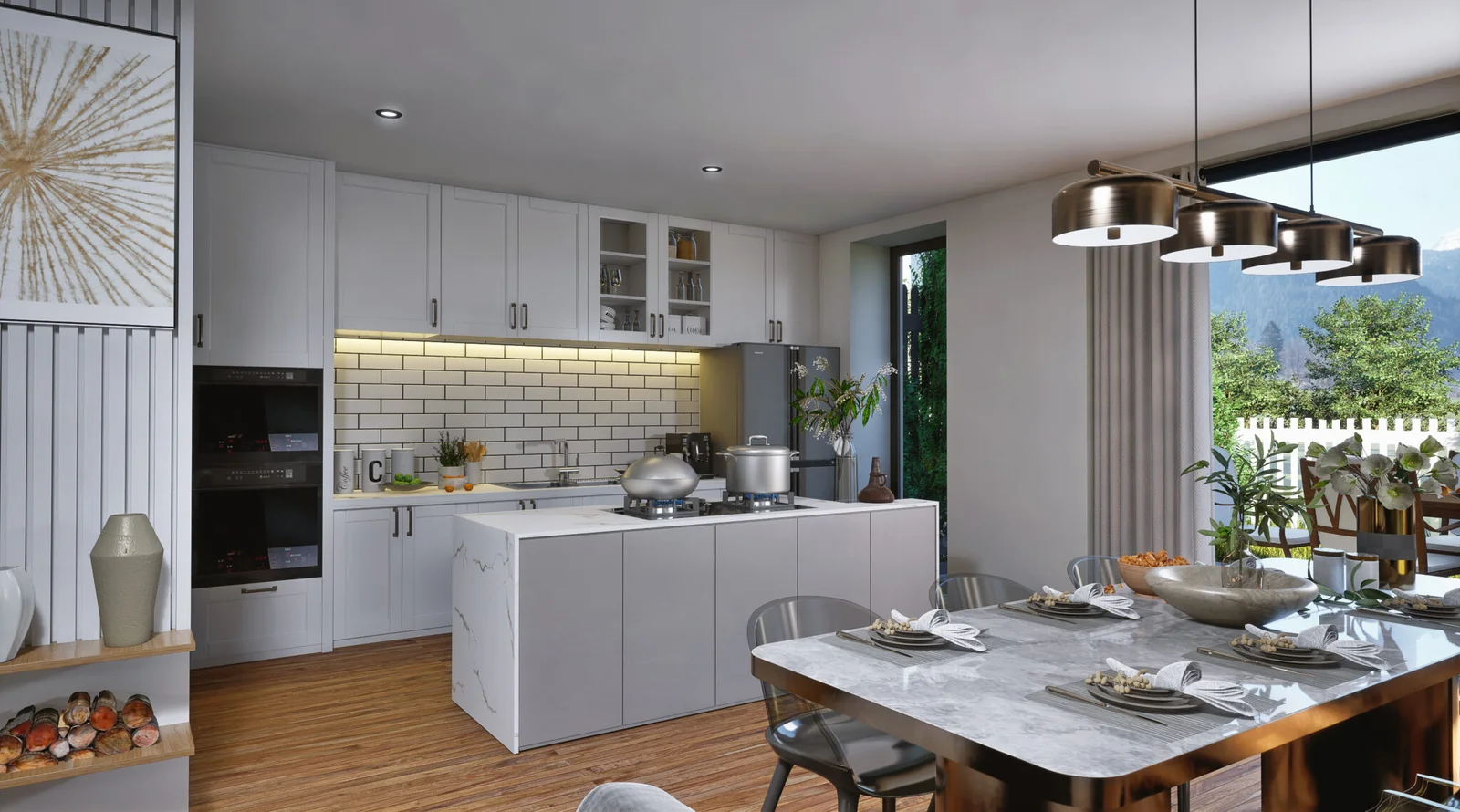
Every finish has neighbours. White cabinetry, a veined island, a tiled splash, timber underfoot, metal pendants overhead: individually, ordinary. Together, the room reads as calm or busy depending on how they are balanced. That is a judgement about the whole, and a board can only hint at it.
This is also where intent gets mangled. If the person building the view doesn’t understand which relationship you care about (the stone is the hero, or the timber is), they will resolve every doubtful choice their own way. You will see it at once in the image, and you will spend a round of revisions putting it back.
What we would want from a board
If you send us a board for a first view, the useful version of it has four things:
- The real references. Supplier names, codes, sample photos. Not “something like this”.
- What is fixed and what is open. Fixed finishes get matched as faithfully as we can. Open ones are a question we would rather show two ways than guess.
- The hero. One sentence on what the room should feel like, and which one or two choices carry it.
- The hour and the window. When is this room used, and what is outside?
With those, a first view becomes a conversation starter for your client, not a verdict. That is the version that gets an early, confident yes, because the client is reacting to your idea rather than to our interpretation of it.
Revisions that are a conversation
A first view isn’t supposed to be right. It is supposed to be useful: precise enough that the client can point at something, and honest enough that you can tell which comments are about the design and which are about the unease of seeing it for the first time.
When a comment comes back, ask what it is protecting. “Can it be warmer?” is often “will we feel comfortable in here?” Treat it as that, and the revision becomes something you work out together instead of something you defend.
The short version
- A board carries taste; a lit view tests it.
- Light, scale and company are what boards can’t show, and where intent is most easily lost.
- Send real references, say what is fixed, name the hero, and give the hour.
- Treat the first view as the start of the conversation with your client, not the end of it.
Have a board you’d like to see lit? Reply with it, along with a line on which room and which finishes matter most, and we’ll tell you what we’d need to turn it into a first view that keeps your intent, and how long that would honestly take.


