
One Sector, One Camera: Why the Same Building Needs a Different Angle in Healthcare, Education, Workplace and Civic Work

Same practice. Same drawing standard. Four sectors. Why would you ever use the same camera for all of them?
Most visualization briefs begin with a list of views: one exterior, one interior, maybe an aerial. The list is neutral. The sector is not. A reviewer reading a healthcare scheme is asking a different question from one reading a workplace fit-out, and the camera is the first place that question gets answered or ignored.
The camera is an argument
Where you put the viewpoint decides what the image claims. Eye height says “you could stand here.” A raised view says “this is how it fits.” A long axial view says “this is how it flows.” None of those is wrong. But each one says something, and if the choice is accidental the image ends up arguing for something you didn’t design.
That is how design intent gets mangled without anyone meaning to. The model is correct, the materials are right, and the image still tells a different story from the scheme.
Workplace: show the rhythm, not one desk
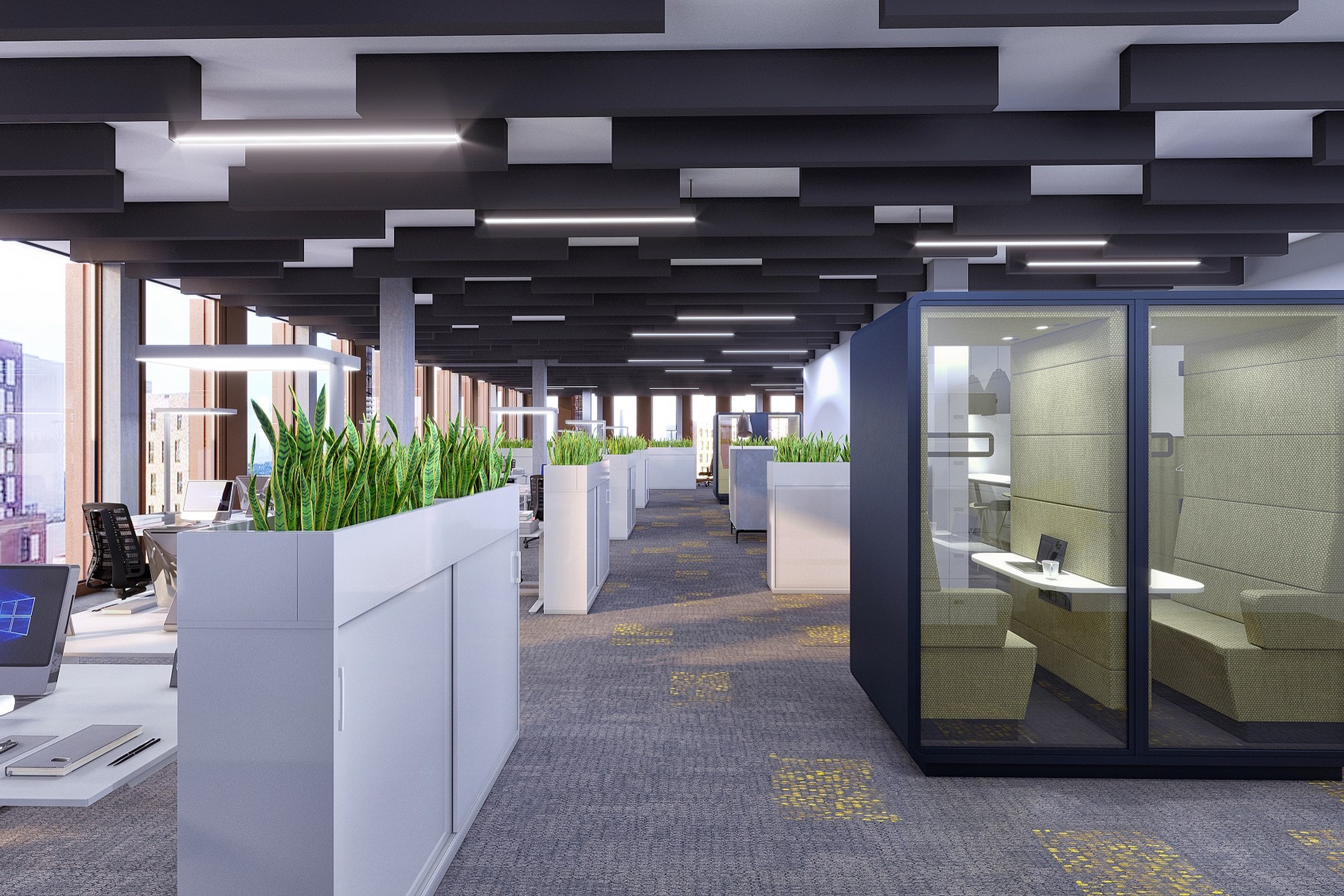
A floor plate is a pattern repeating. A view straight down an aisle at eye level lets the viewer feel that repetition and, more usefully, see where it is interrupted: the pod, the planter line, the change in the ceiling. Those interruptions are usually where the design thinking lives.
A corner shot of one tidy desk loses all of it. For workplace, we would start from the long view and the moment where the plan changes character.
Civic: show the site before the door
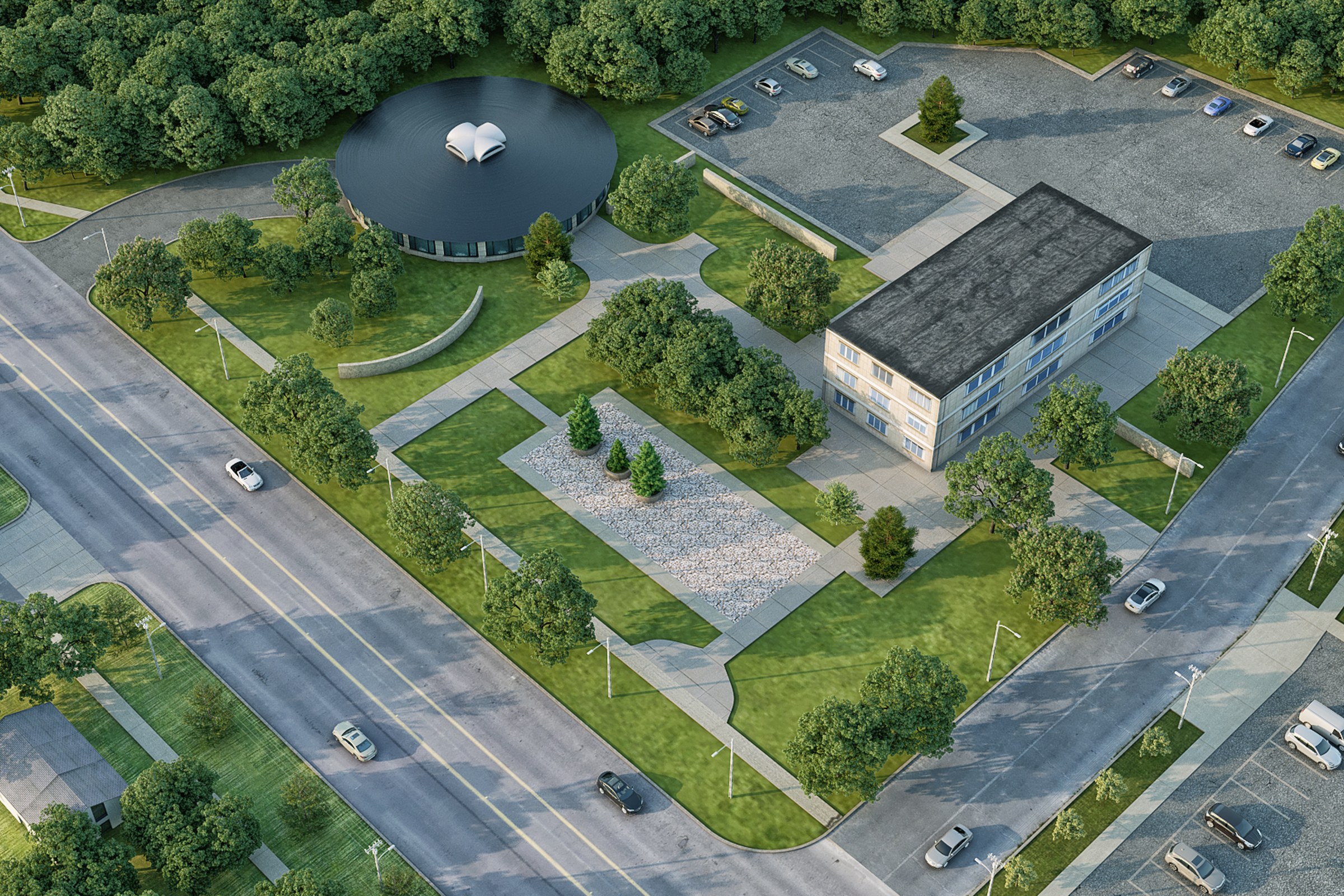
Civic work is read in public. People care how a building sits among its neighbours, how you arrive, and what the edges give back to the street. A raised oblique view makes that legible in one glance: the paths, the planting, the relationship between the two buildings and the road.
For this kind of scheme, the question to settle early is who the first image is for. If it’s for a review, the site view leads. If it’s for the people who will use the place, the arrival at ground level leads. Often it is both, and the order is the decision.
Healthcare and education: the quiet sectors
We haven’t put images of them here because we would rather show you work in context than stand in a placeholder. But the principle is the same, and the questions are worth asking before any view is commissioned:
- Healthcare. Who is looking, and in what state? A view that suits a board may not suit a patient arriving anxious. What does the route from door to desk feel like, and does the first view protect that?
- Education. Is the story the building or the day inside it? Learning spaces are about occupation and daylight; a pristine empty room can undersell a scheme that was designed for use.
Neither answer is universal. Both change the angle.
What keeps intent alive through the render
Across sectors, the same few habits protect your design:
- Name the one thing the image must show. One sentence. Everything else yields to it.
- Say what’s fixed and what’s open. Fixed items are matched to your references; open ones can be shown two ways.
- Agree the viewpoint on a simple block view before anything is finished. Moving a camera early costs a conversation. Moving it late costs a round.
- Treat comments as a conversation. “Can it feel lighter?” is usually a question about the room, not the render. Ask what it’s protecting.
The short version
- The camera makes an argument; choose it on purpose.
- Workplace wants the rhythm, civic wants the site, healthcare and education want to know who is looking.
- Agree the viewpoint early and name the one thing it must show.
Which sector are you bidding hardest in this quarter? Healthcare, education, workplace or civic: reply with one word, and we’ll send back the single camera-angle approach we would use for it. No call needed.


