
Which Scheme Is Nearest the Deadline? How to Sequence Stills and a Short Flythrough

Whichever scheme is closest to a deadline should get its images first. Not its best images. Its first images.
Most practices we talk to have three or four schemes live at once. One of them has a presentation on the calendar, or a submission with a date on it. The others are further out. And when it comes to visualisation, the question that quietly causes the most trouble is not “how many images” or “what style”. It is the order.
So here is a way to think about it. Start from the deadline, then work back to what each format is good at.
Stills and a flythrough do different jobs
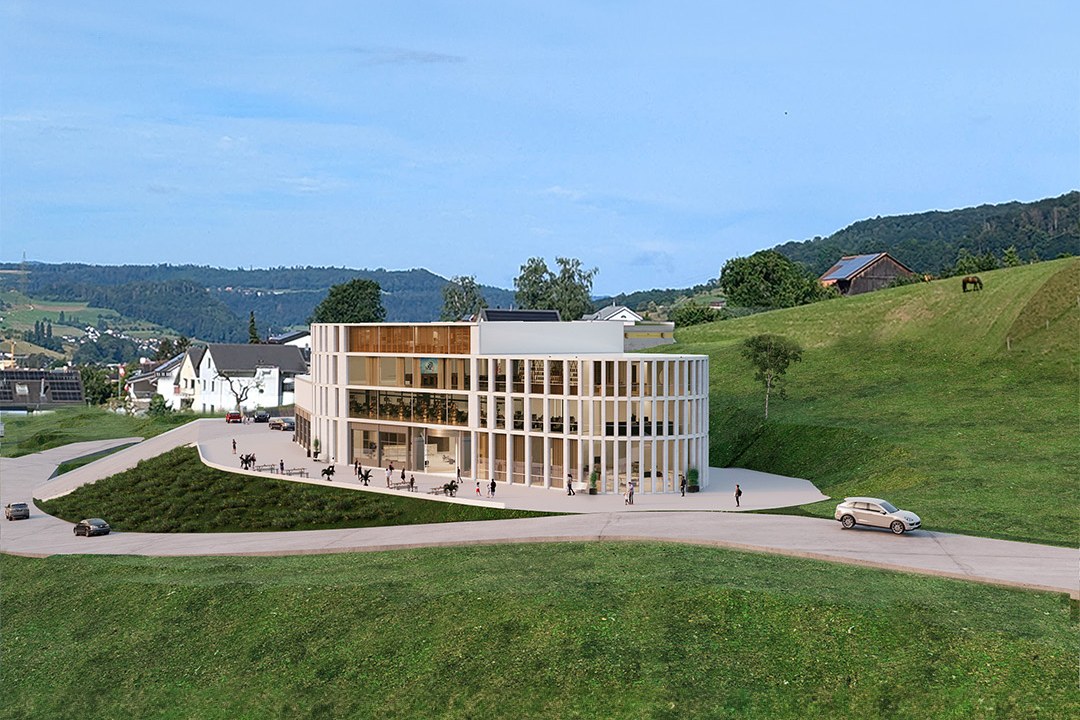
A building like this one, sitting on a slope with a road curving past it, is a good example of why the two formats are not interchangeable.
A still is a decision. You choose the viewpoint, the light and the moment, and you ask the reader to agree that this is the building. Stills are what a panel reads, what goes into a submission book, what gets pinned to a wall. They are also where design intent is easiest to check: you can lay one beside your elevations and see whether the rhythm of the colonnade or the depth of the terrace survived.
A short flythrough is an argument about sequence. It answers questions a still cannot: how you arrive, how the building sits against the fall of the land, what you see first and what you find later. It is a good format for a client or committee who needs to understand a place rather than judge a façade.
Neither is better. But they are not equally fast to get right, and they do not fail in the same way.
Why stills usually go first
When a date is close, we would lean towards stills first, for three plain reasons.
- They settle the design questions the flythrough depends on. Materials, light and the read of the main façades get agreed once, in a form you can mark up. A moving sequence then inherits those decisions instead of reopening them.
- They are easier to correct. A note on a single frame is a small conversation. The same note found inside a moving sequence touches everything around it.
- They give you something to show sooner. If the deadline moves earlier, you already have images that stand alone.
That is not a rule. A scheme whose whole case is the journey, an arrival sequence or a site that only makes sense in motion, may want the camera path planned from day one. But even then, the key frames are worth locking as stills before the movement is built around them.
A short flythrough earns its place when the question is “how does it sit”

Places like this one, a low, spread-out composition of pavilions around a pool, are where a moving view starts to pay. One frame shows the pool and the two flanking pavilions. It cannot show how the shaded seating relates to the water, or how you move from one edge to the other. A short pass can.
Keep it short. A flythrough that tries to show everything tends to show nothing memorably. Pick the two or three moments that carry the scheme, and let the stills carry the detail.
And a still is right when the question is “what is it made of”

Here the story is in the surfaces: the stucco against the timber cladding, the depth of the canopies, the line of the angled roofs. That is a still’s territory. A reviewer needs to stop on it, compare it, and mark it up. Nothing about that gets easier at twenty-four frames a second.
A simple way to sequence it
If you are weighing this for a live scheme, here is the order we would suggest thinking in.
- Name the deadline and the audience. A committee, a client board and a tender panel each read differently.
- Lock the defining views as stills. The one or two that carry the scheme, checked against your latest drawings.
- Decide what only motion can answer. If the answer is nothing, you may not need one yet.
- Then plan the flythrough from those frames. Same materials, same light, same decisions, now in sequence.
- Agree who marks up what, and when. Revisions are a conversation when everyone knows which round they are in.
One word is enough
We are not going to pretend there is a formula. It depends on the scheme, the room it will be shown in, and how much is still moving in the design.
But we would like to help you sequence it. If you tell us, in one word, which of your live schemes is closest to a presentation or submission date, we will reply with how we would order stills against a short flythrough for it, and what we would ask you first.
Which of your live schemes is closest to a deadline? Reply with one word: the project’s name will do. We will send back how we would sequence stills and a short flythrough for it. No call needed.


