
When a Sample Says More Than Another Email: How to Read a Visualisation Portfolio for Design Intent

Most emails about visualisation say the same thing. The work is the only part that can’t.
If you design buildings or rooms, your inbox already holds plenty of promises. Fast, precise, collaborative. Every studio writes the words, so the words stop telling you anything.
A sample does. Not because it is pretty, but because a well-made image is a record of a hundred small decisions, and you can check each one against your own eye. This is how we would read one if we were on your side of the table.
Start with the part nobody photographs
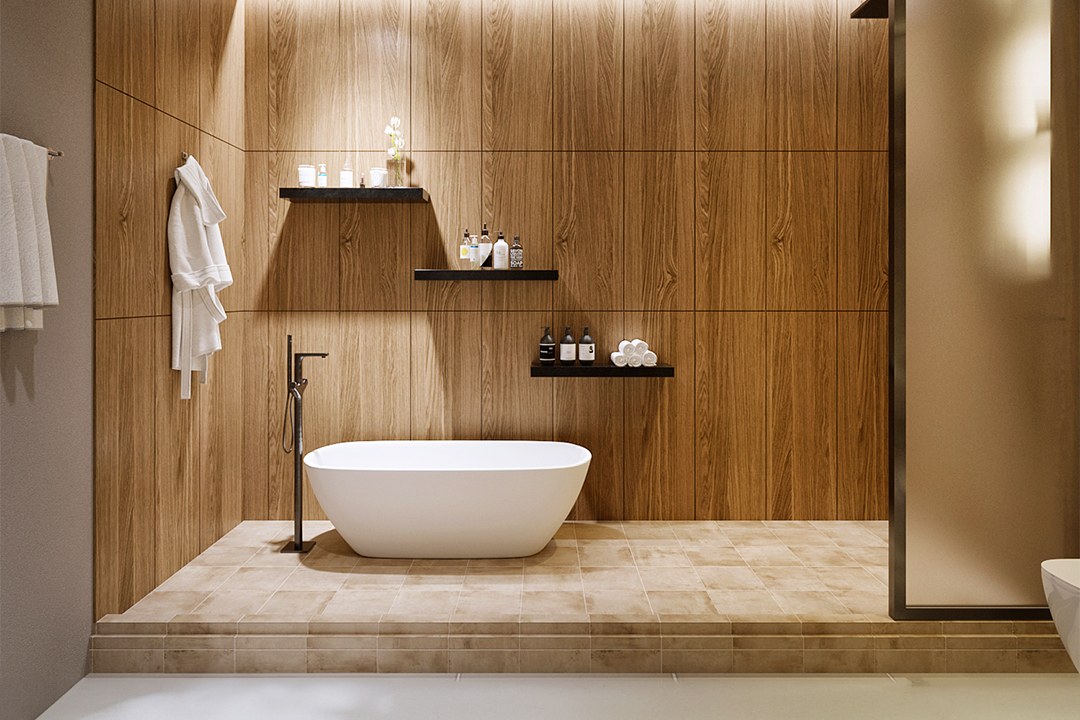
Look at the wall in a room like this one. The timber is the whole mood, and it is also where a careless render gives itself away. Does the grain run the way real veneer would, and does it change from panel to panel? Do the panel joints line up with the shelves, or wander? Does the plinth step meet the bath the way a joiner would build it?
None of that is flashy. All of it is design intent: the proportion of a panel, the rhythm of a joint, the height of a step. If a studio holds those quietly in an image they chose to show, they will likely hold them in yours.
Four things worth checking in any sample
- Joints and edges. Where two materials meet, is the junction resolved or smudged? This is the first place intent is lost.
- Light that behaves. Is the light coming from somewhere you can point to? A hidden strip, a window, a wall light. Light with no source is decoration.
- Restraint. Is anything in the frame there only to impress? Intent survives in images that know what to leave out.
- Consistency across a set. One strong image proves little. Two or three in a row, with the same care in the corners, prove a lot.
Then look at the small, hard rooms
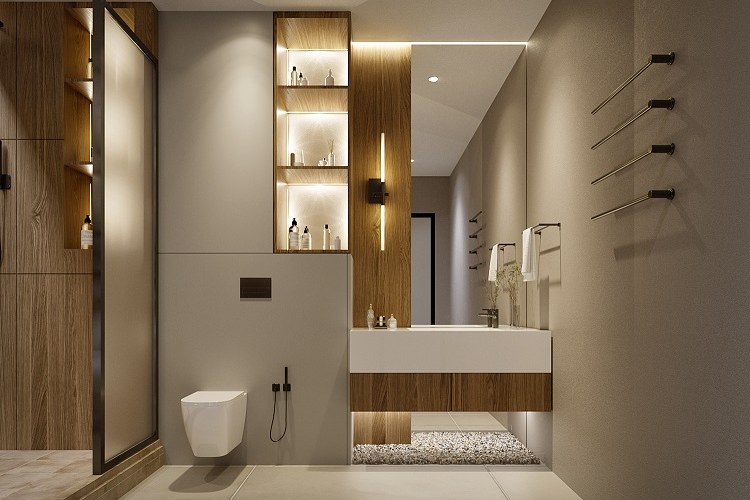
Compact interiors are the honest test. Everything is close to the camera, so every detail is visible: the backlit niches, the vanity floating above its own glow, the way a tall light sits against a timber return. There is nowhere to hide a vague material or a lazy corner.
If a practice of yours designs rooms like this, this is the kind of image to ask for. Not the grand lobby. The cupboard-sized room where the detailing is the design.
Why a sample can beat a further email
An email can describe care. A sample shows it, and lets you decide in a minute or two without a call. That is the reason we keep the work easy to find rather than adding another message about it.
If you are weighing a collaborator, ask for the closest thing to your own typology and look at it the way we have just described. Judge the joints, the light and the restraint. Then decide whether the next conversation is worth having. If it is not, that is a perfectly good answer.
Prefer to look first and talk later? Our work is gathered in one place, grouped by type. Take a look at whatever sits nearest your project and ignore the rest.


