
Twenty Seconds of Camera, Without Redrawing the Scheme

A still image can hide one mistake. A moving camera shows every frame of it, back to back, in the order a buyer will see them.
When a developer asks for a short flythrough to sit in a pre-sales portal, the brief usually arrives as a runtime and a file size. Twenty seconds. Plays on a phone. Loops.
What it does not mention is the thing you care about most: the building has to be the same building in second one and second nineteen.
That is the real craft problem in a short film, and it is a design problem before it is a technical one. Here is how we think about it, and what is worth putting in writing before anyone opens a 3D scene.
1. A repeated detail is a promise

A row of homes like this one is built on repetition with small variations: a balcony here, a gable there, an entry canopy that recurs at a steady interval. In a still, you check that rhythm once.
In a film, the camera glides along it. If a canopy changes depth between units, or a balcony rail is thicker in one shot than another, the eye catches it even when nobody can say what moved. The drawings said one thing; the film now says several.
What to ask for: a single approved model driving every shot, so a detail is defined once and appears the same way everywhere the camera looks.
2. The camera should walk where a person would
Speed and height are the two decisions that most quickly make a scheme feel either honest or inflated. A camera that climbs fast and swoops makes everything look bigger, closer to the sky and easier to love than it will be in life.
We prefer the opposite instinct for architect-led work. Start where someone would first arrive. Move at a pace a person could keep up with. Let the building reveal itself in the order its plan intends: street, approach, threshold. Twenty seconds is short, but it is long enough for exactly one idea, and that idea should be the one in your design statement.
What to ask for: a one-line description of the move (“arrive from the street, drift along the frontage, end on the entry”) agreed before production, so the camera serves the scheme and not the other way round.
3. Leave the neighbours in
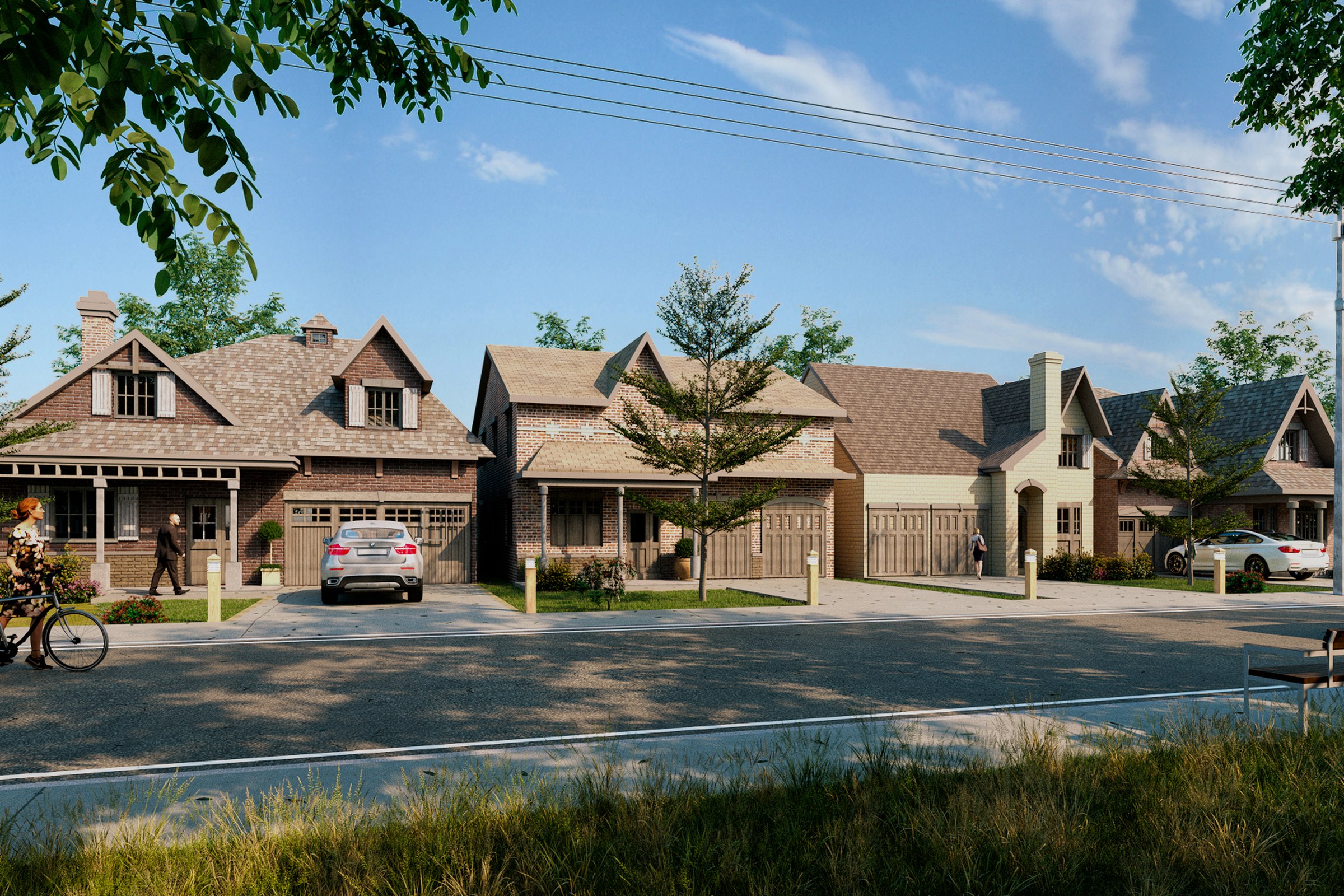
People, a bench, a tree at the kerb, the existing edge of the street: these are not set dressing. They give a buyer the scale and the sense of place that the plan promises but a drawing cannot show.
In motion they matter even more, because a moving camera past an empty, spotless frontage feels like a model, and one past a street with ordinary life in it feels like somewhere you could live. It also keeps the piece honest. When the finished building is eventually held up against the film, the context should still match.
What to ask for: the surroundings drawn from the real site and shown as designed, with nothing tidied away that will still be there on completion day.
4. Size it for where it will be watched
A film for a sales portal and paid social is watched small, often muted, and usually without a second chance. That changes the edit, not the architecture:
- Frame for a thumb-sized screen. Keep the key silhouette large and the move slow enough to read.
- Let it work without sound. The first two seconds should already say what the building is.
- Make it loop cleanly, so a portal visitor who lingers does not meet a hard cut at the best part.
- Deliver the formats at the start, not as an afterthought: portal, social crop, and a version for the buyer deck.
The short brief that protects all of it
Before a flythrough is commissioned, put these four lines on one page:
- The fixed points. The proportions, materials and details that are not up for reinterpretation.
- The move. One sentence describing where the camera starts, travels and ends.
- The context to keep. The neighbours, trees and street edges that are part of the story.
- What is still undecided. Say so plainly. A good collaborator leaves open things open rather than inventing them.
With that in hand, revisions become a conversation about whether the film matches the building you designed, and not a negotiation about taste. That is the whole difference between a visual partner who reads your drawings and one who quietly redraws them.
Working on a scheme heading to pre-sales? Tell us the move you want and the details that must not change, and we’ll send back a free angle idea that respects both.


