
Proof at your scale
What getting a firm your size through review actually looked like.
Design-review case studies are not hard to find. Most of them, though, belong to firms with an in-house viz department, a marketing team, and a project the size of a city block — none of which describes a ten-person practice with one partner in the review room and a scheme that has to earn its approval on its own merits, not on the studio's name behind it. The gap that actually matters for a firm that size isn't "did a render help someone" — it's did the design survive the process it went through, at a scale that looks like mine.
So instead of another list of what a submittal should contain, here is one project, run at that scale, with the real before-and-after.
The render isn't the collaborator's job — protecting the intent through revision is
What a firm your size is actually buying isn't a picture — it's a collaborator who can carry a design's intent through however many rounds review takes without quietly flattening it into something safer. At a ten-person practice, there's no in-house team to catch a viz partner who over-simplifies a massing move or drops a material read because it was easier to render. The partner in the room is often the only person who will notice, and by then the package is already printed.
That's what makes a revision loop worth watching, not just a finished image. A markup mark isn't a complaint — it's the client and the design team arguing their way to precision, and the studio's job is to keep up with that argument through however many passes it takes, not to defend the first pass.
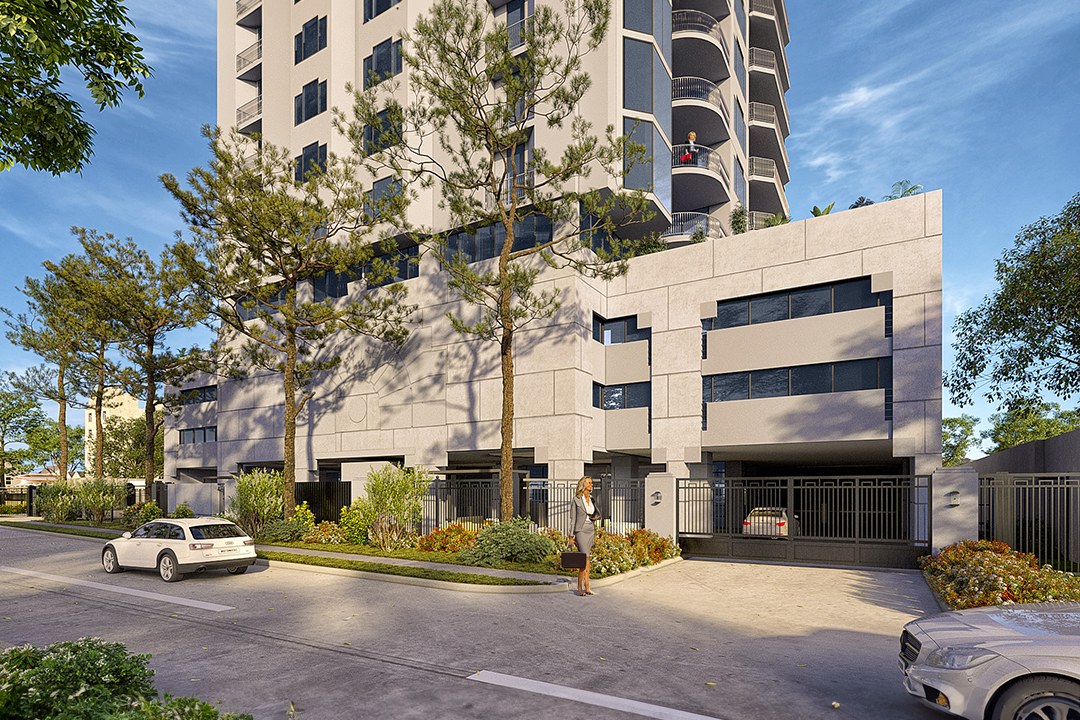
A mixed-use commercial scheme, reworked through review, approved
The scheme went through genuine iterative markup rounds with the client — an early massing pass, real hand-annotated corrections, a revised scheme, and the version that was finally approved. Nothing about the project or the review process is dramatized here: no invented board, no vote count, no manufactured objection. It's a commercial-scale mixed-use development, the kind of project a mid-size US practice actually takes on, worked through stakeholder review to a signed-off final.
The full before/after — the early markup, the revised massing, the approved scheme — is on the case study itself, not summarized here. That's deliberate: a screenshot of a render is not proof; the actual review trail is.


