Contemporary Home Office Bookshelf
Contemporary Home Office Visualization
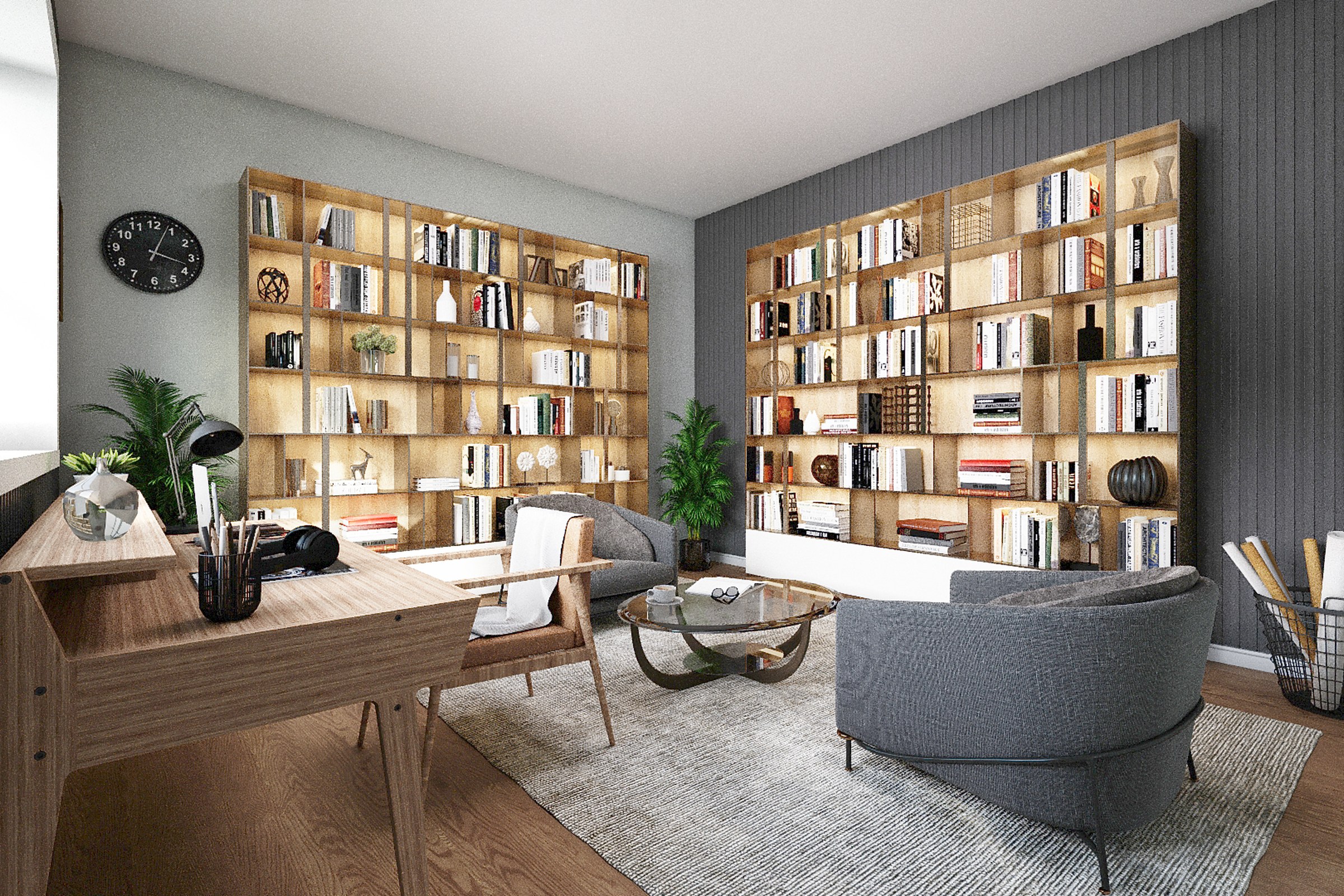
Home office / study with large wooden bookshelf wall, mid-century desk, barrel armchair, glass coffee table, dark paneled accent wall, and ample natural light.
Project Overview
In early 2026, 3D Praxis Studio was approached by a client seeking to visualize a contemporary home office space that seamlessly integrates a bookshelf into the overall design. The client, an architect based in the UK, wanted to create a functional yet aesthetically pleasing environment that would inspire creativity and productivity. The project was straightforward but required careful attention to detail to ensure that the home office reflected the client’s vision.
Ravi, a senior 3D artist at the studio, took the lead on this project. With over a decade of experience in architectural visualization, he understood the importance of balancing form and function. The team collaborated closely with the client, discussing their preferences for materials, colors, and layout. The goal was to create a space that felt inviting and organized, making it an ideal setting for both work and relaxation.
Throughout the process, the team worked diligently to incorporate the client’s feedback, making adjustments to the design as needed. The final render showcased a harmonious blend of modern design elements, with a focus on the bookshelf as a central feature. The project was completed within the agreed timeline, demonstrating the studio’s commitment to delivering quality work efficiently.
Technical Approach
To achieve the desired look for the home office, the team utilized 3ds Max and V-Ray for rendering. A key technical detail was the use of natural light to enhance the ambiance of the space. The team set up a daylight system to simulate sunlight streaming through large windows, creating soft shadows that added depth to the scene. The bookshelf was crafted using a combination of wood textures and finishes, ensuring it complemented the overall design while standing out as a focal point.
The Result
The final visualization met the client’s expectations, capturing the essence of a contemporary home office that was both functional and inviting. The client expressed satisfaction with the outcome, appreciating the attention to detail and the realistic representation of the space.
Have a project like this? Let’s talk or explore more work.
Project Overview
Contemporary Home Office Bookshelf was a quick-turn engagement. The interior designer had a design they were proud of and needed it visualized — no extras, just one precise, photorealistic render.
Home office / study with large wooden bookshelf wall, mid-century desk, barrel armchair, glass coffee table, dark paneled accent wall, and ample natural light.
The Result
The final output landed within 3-5 days. Clean, high-resolution, ready for print and screen. It’s been the visual backbone of this project’s public-facing materials.
If this is the kind of quality you’re after, start a conversation with us. Or explore the full portfolio.