Nitinbhai Highrise Towers
Contemporary High Rise Visualization
Explore our 3D exterior rendering of the Nitinbhai Highrise Towers, showcasing multi-family living spaces. Discover quality architectural visualization today.
Project Overview
The scope for Nitinbhai Highrise Towers was substantial — 5 images for a multi-family residential project that the real estate developer was preparing to take public. Every image had a purpose, from investor decks to the project website.
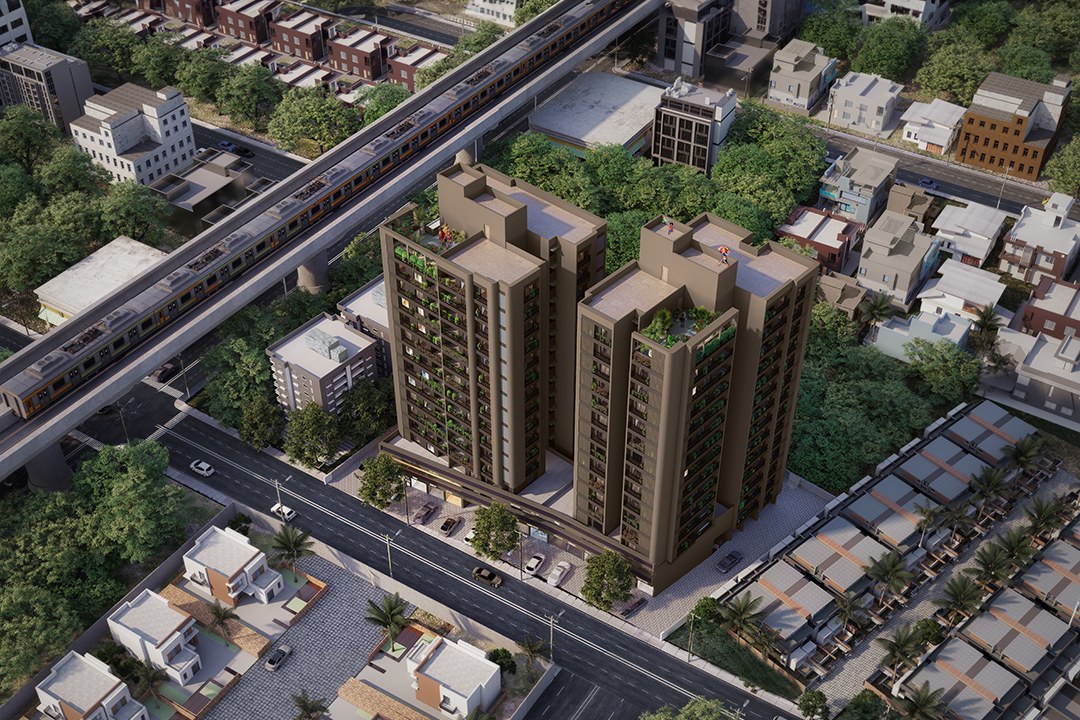
Bird’s-eye aerial view of twin 12+ story Indian residential towers in a dense urban context with an elevated metro rail line passing nearby, rooftop greenery, parking podium, and surrounding low-rise neighborhood.
The Challenge
The biggest hurdle was fidelity at scale. With 5 compositions to produce, we couldn’t afford to let quality drift between the first render and the last. Every image needed to feel like it came from the same visual universe.
At 5 deliverables, there’s a real risk of redundancy — views that look too similar or don’t add new information. We planned the camera positions deliberately so every image earned its place in the set.
Stakeholder alignment was part of the challenge. Multiple decision-makers had different priorities for what the renders should emphasise, and we had to find compositions that satisfied all of them without diluting any single perspective.
Our Approach
Feedback cycles were structured. We presented renders in context — placed into the marketing layout or presentation deck — so the real estate developer could evaluate them as their audience would see them, not as isolated files on a white background.
The rendering pipeline was set up to handle 5 outputs efficiently. Shared lighting rigs, consistent material libraries, and a standardised colour pipeline meant every image maintained the same visual standard.
The modelling phase was methodical. We built the geometry from the architectural plans, cross-referencing elevations and sections to catch anything that might read differently in three dimensions than it does on paper.
Landscape and entourage came last but mattered enormously. Trees, people, vehicles, sky — these contextual elements are what make a render feel like a photograph instead of a diagram.
We ran the first round of test renders at reduced resolution to get quick feedback on composition, materials, and overall mood. This let us catch issues early when changes were cheap, not late when they weren’t.
The Result
Delivery took 3-4 weeks from kick-off to final files. The 5-image set now powers the project’s online presence, sales centre displays, and social media content.
Working on something similar? Let’s talk about your project — or browse more of our work.