Project 81 Yellow Traditional Home
Traditional Single Family Visualization
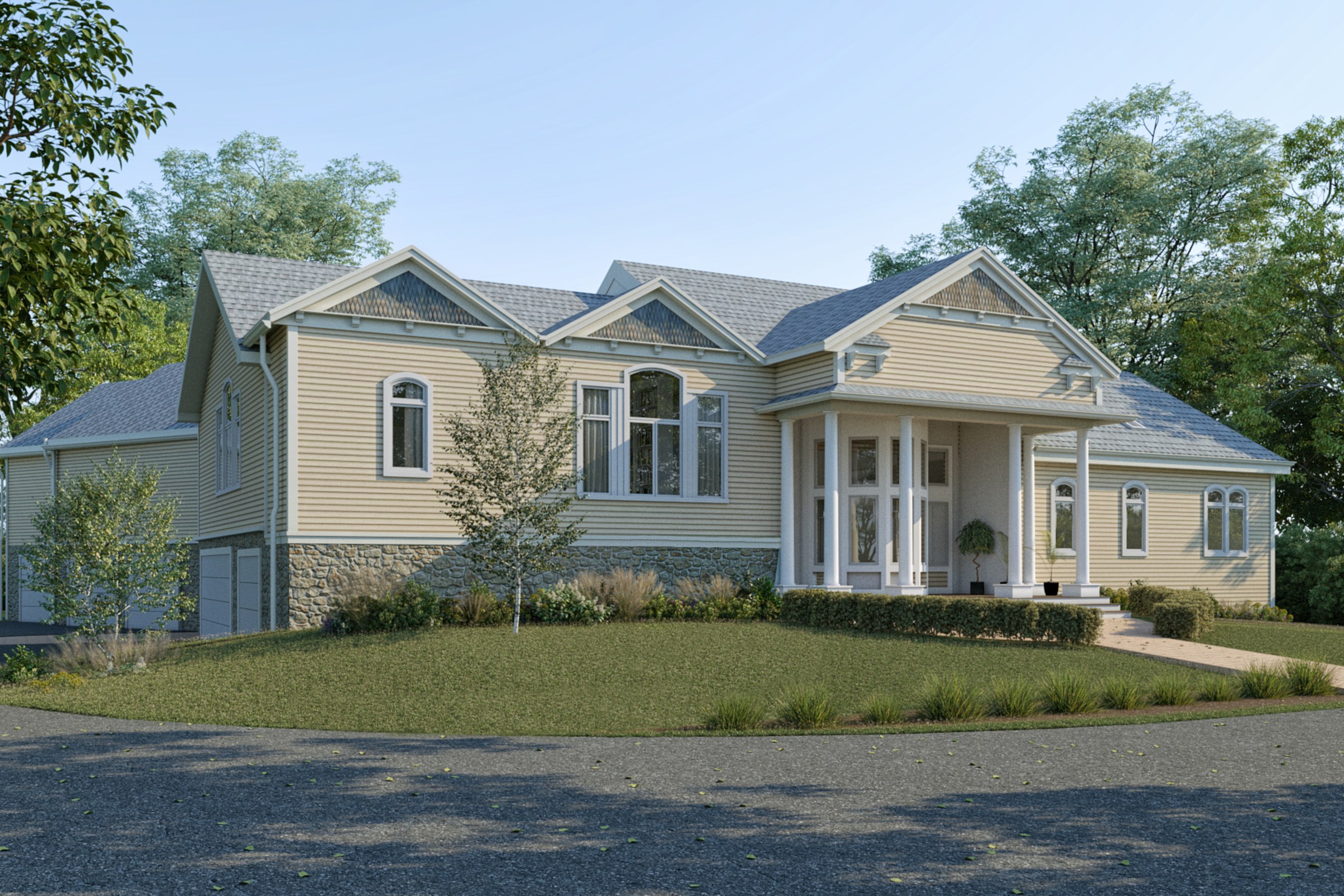
Yellow siding traditional home with arched windows, columned front portico, stone foundation, attached garage, and circular driveway.
Project Overview
A residential architect in Malibu sent us this project in early 2025 — a traditional single-family home with yellow siding, arched windows, a columned front portico, stone foundation, attached garage, and a circular driveway. The client preferred to remain confidential, but the ask was clear: one front-elevation rendering for a homeowner presentation, delivered in under a week.
Neha, one of our senior artists, took the project. She has handled enough traditional American residential work over the years to spot the common pitfalls immediately. Yellow siding is one of them. In a rendering, yellow can go wrong in dozens of ways — too bright and the house looks like a cartoon, too muted and it looks beige, too warm and it clashes with the stone foundation, too cool and it reads as institutional rather than residential.
The architect had chosen a particular shade — a muted butter yellow with a slight warmth — and sent a physical paint swatch photographed in natural light. Neha spent the first morning calibrating the siding material against that swatch under three different HDRI lighting setups before settling on the final value. This is the kind of invisible work that clients do not see but would immediately notice if it were wrong.
The arched windows were a defining feature. Traditional homes use arched windows to add visual rhythm and formality, but in a rendering, the arch geometry has to be precise — a slightly pointed arch reads as Gothic, a perfectly semicircular arch reads as Romanesque, and a flattened arch reads as Federal. The architect’s drawings called for a segmental arch, which sits somewhere between flat and full. Neha modeled each window with the exact rise-to-span ratio from the drawings.
The columned front portico was the compositional anchor. Four columns supporting a triangular pediment, in what is essentially a compressed version of classical temple-front architecture. The columns needed to look like painted wood, not stone — there is a different surface quality, a slight softness to the reflections that distinguishes wood from masonry even under paint.
The circular driveway was a practical composition tool. It leads the eye from the foreground to the front door and gives the image a sense of arrival. Neha placed subtle tire marks on the drive surface — the kind that build up over months of use — to make the home feel lived-in rather than just built.
Technical Approach
The daylight rendering used a V-Ray Sun positioned for late morning to avoid harsh noon shadows while keeping the facade fully illuminated. The yellow siding used a V-Ray material with a slight SSS (sub-surface scattering) component — real painted wood absorbs a tiny amount of light rather than reflecting all of it, and this gives the siding a softer, more natural appearance than a purely diffuse material. The stone foundation used a procedural V-Ray displacement with hand-painted weight maps to control where the mortar joints were deeper or shallower, simulating the variation of real stonework. The front elevation viewpoint was positioned at a slight three-quarter angle rather than dead-on, giving depth to the portico and showing the garage wing receding — a flat front elevation would have made the house look like an architectural drawing rather than a photograph.
The Result
The architect presented the rendering to the homeowner, who approved the exterior design without requesting changes to the color or materials. The architect mentioned this was unusual — exterior color is typically the most-revised element in residential projects. The accurate color calibration from the physical paint swatch had paid off. The project moved to construction documents the following week.
Tips for Residential Architects
-
Send physical material references when color is critical. A photographed paint swatch in natural light gives us a target we can calibrate against. Digital color codes from manufacturer websites are often inaccurate due to screen variation.
-
Specify the arch profile for traditional windows. Segmental, semicircular, and elliptical arches all read differently and carry different stylistic associations. Calling out the exact profile in your brief prevents us from defaulting to a generic shape.
-
Add life to the driveway. A pristine driveway says ‘unbuilt.’ Subtle tire marks, a slightly weathered surface, and a car parked casually rather than centered all help a rendering feel like a home rather than a model.
Have a project like this? Let’s talk — or explore more work.