Veterans Memorial Park
Contemporary Civic Perimeter Wall Gate Visualization
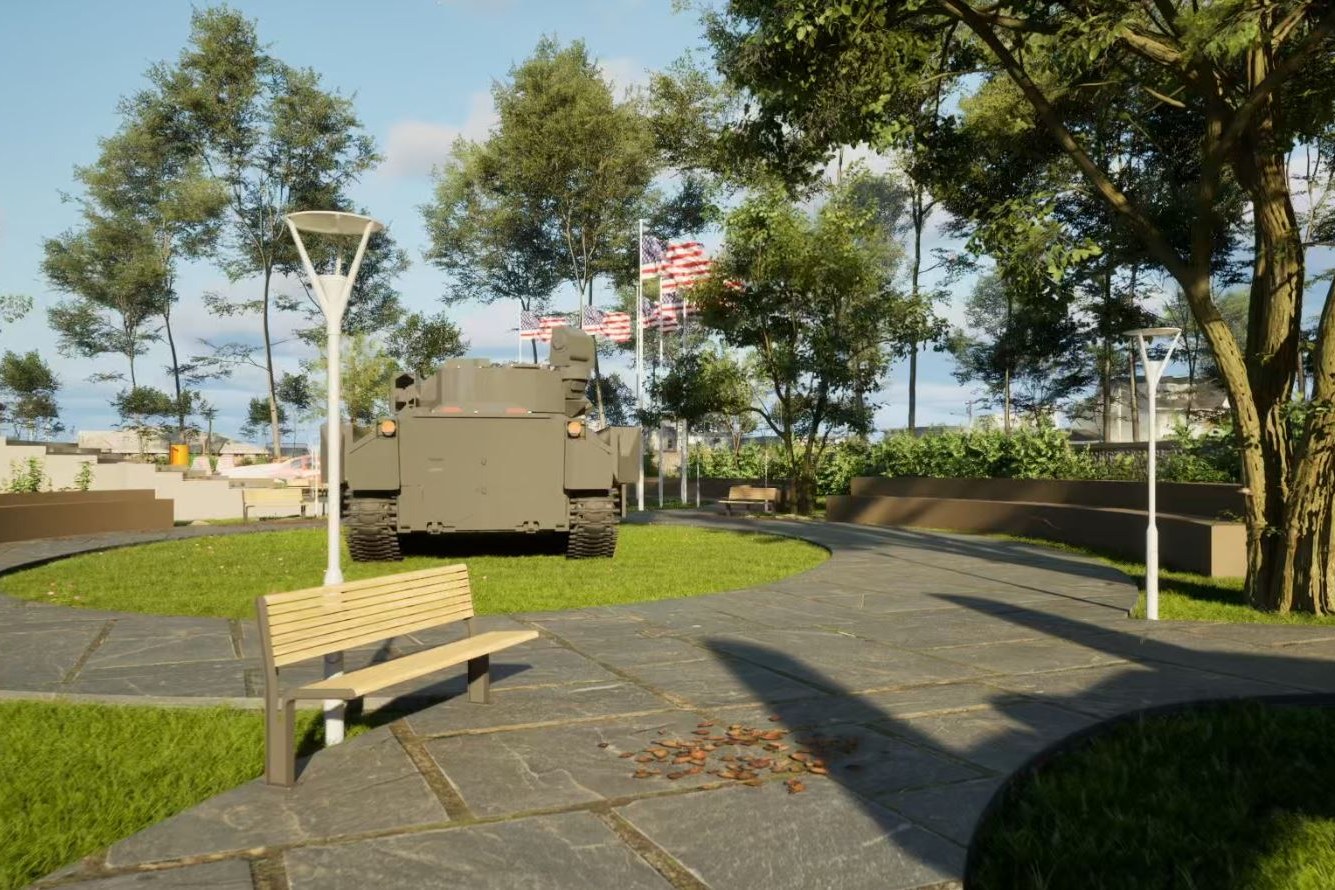
3D rendering of a veterans memorial park featuring a military armored personnel carrier (APC/tank) displayed on a circular grass island. American flags fly on poles in the background. Modern Y-shaped street lamps, wooden park benches, and flagstone pathways with circular layout surround the display. Mature trees and a residential neighborhood are visible beyond a perimeter wall. Civic memorial atmosphere with strong patriotic elements.
Project Overview
The scope for Veterans Memorial Park was substantial — 6 visualizations for a landscape project that the landscape architect was preparing to take public. Every image had a purpose, from investor decks to the project website.
3D rendering of a veterans memorial park featuring a military armored personnel carrier (APC/tank) displayed on a circular grass island.
The Challenge
The biggest hurdle was fidelity at scale. With 6 compositions to produce, we couldn’t afford to let quality drift between the first render and the last. Every image needed to feel like it came from the same visual universe.
Each viewpoint served a different audience. The hero shot needed marketing punch. The detail views needed technical precision. The aerial needed context. Making all of them feel cohesive while serving different purposes was the real puzzle.
Stakeholder alignment was part of the challenge. Multiple decision-makers had different priorities for what the renders should emphasise, and we had to find compositions that satisfied all of them without diluting any single perspective.
Our Approach
The rendering pipeline was set up to handle 6 outputs efficiently. Shared lighting rigs, consistent material libraries, and a standardised colour pipeline meant every image maintained the same visual standard.
Feedback cycles were structured. We presented renders in context — placed into the marketing layout or presentation deck — so the landscape architect could evaluate them as their audience would see them, not as isolated files on a white background.
Camera positions were planned, not improvised. We mapped out eye-level, elevated, eye-level-centered angles based on the project’s strongest design moments, then refined framing through a series of grey-shaded test renders before committing to final production.
Material selection was hands-on. We sourced textures from manufacturer libraries and matched them against the specification documents. Where specs were ambiguous, we sent samples to the landscape architect for sign-off before rendering.
Lighting development ran parallel to the modelling. We tested multiple Daytime setups early — before the geometry was even finished — so we could lock in the mood and atmosphere without burning production time later.
The Result
We wrapped production within 2-3 weeks, delivering 6 final renders optimised for both digital and print. The hero shot leads the project’s marketing, and the gallery views round out the full story.
Have a project in mind? Drop us a brief and we’ll get back to you with a quote within a day. Or see what else we’ve done.