Project Colonial Office
Colonial Traditional Institutional Office Visualization
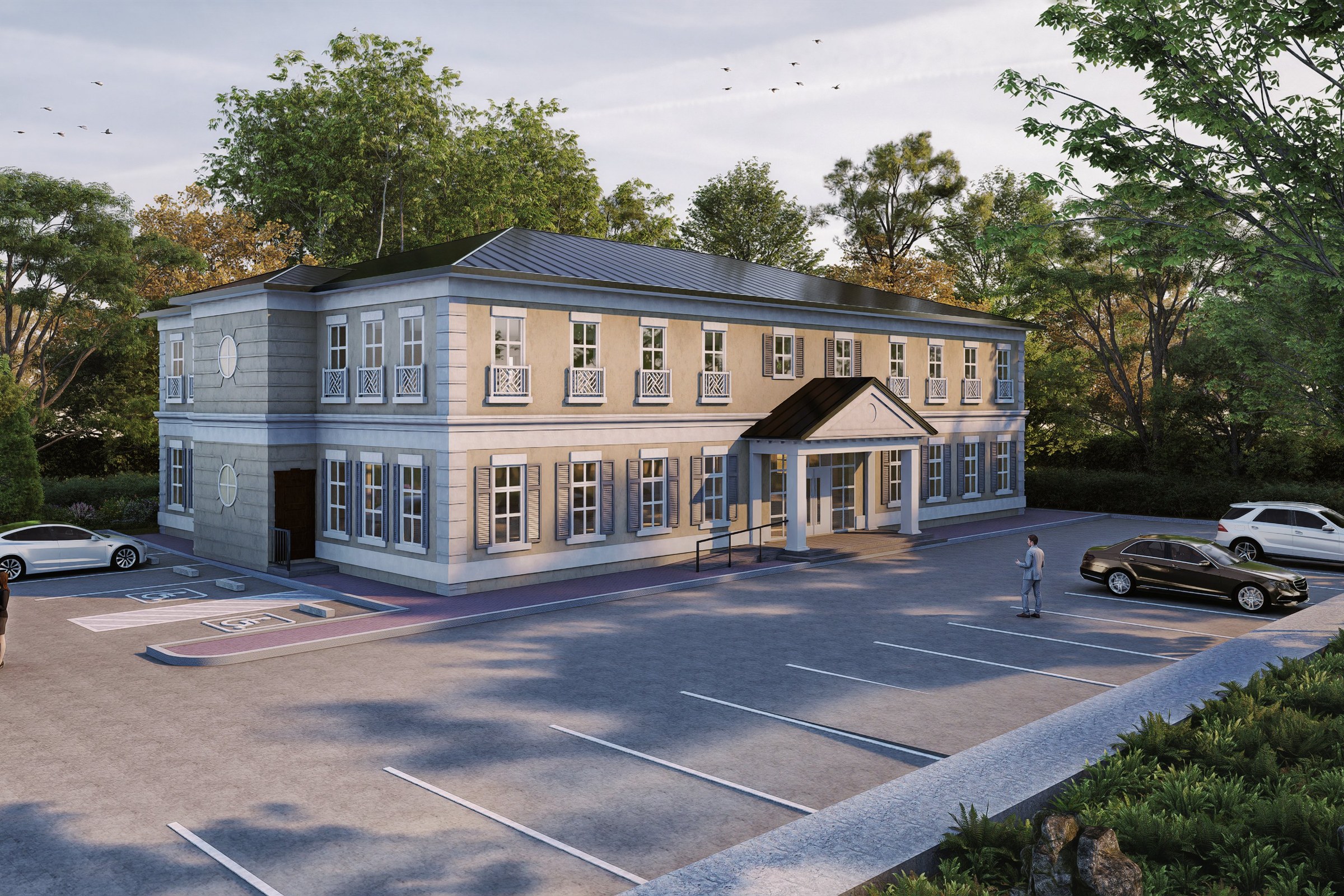
Same colonial-style two-story office building from an elevated front angle at dusk. Classical portico entrance with columns, symmetrical windows with shutters, stone facade with cream paint. Parking lot in foreground. Lush tree surroundings.
In our recent project for the Colonial Office, we were tasked with creating a striking exterior rendering that would capture the essence of the client’s vision for a modern yet timeless institutional building. The client needed a compelling visual representation to aid in securing planning approval and to effectively communicate their design intent to stakeholders, including local authorities and potential investors.
Our approach to this project was rooted in a deep understanding of the architectural context and the client’s aspirations. We collaborated closely with the architects to ensure that every detail was meticulously represented, from the building’s façade to the surrounding landscape. What made this rendering unique was our commitment to photorealism, achieved through a combination of advanced techniques and a keen eye for detail. We emphasized the interplay of light and shadow, which not only highlighted the architectural features but also created a welcoming atmosphere that would resonate with the community.
To bring this vision to life, we utilized industry-leading software such as 3ds Max and V-Ray, allowing us to create highly detailed textures and realistic lighting scenarios. We carefully selected materials that reflected the intended aesthetic of the building, ensuring that the brickwork, glass, and metal elements harmonized beautifully. Our team paid special attention to the time of day depicted in the renderings, capturing the warm glow of the golden hour to enhance the building’s appeal.
The final result was a stunning visual that not only met but exceeded the client’s expectations. The high-quality renderings played a crucial role in securing planning approval, as they effectively conveyed the project’s vision to the local council. Additionally, the visuals were instrumental in marketing efforts, helping the client attract potential investors and generate excitement within the community. This project exemplifies our commitment to delivering exceptional architectural visualizations that drive success for our clients.
Project Overview
Project Colonial Office wasn’t just another rendering job — it was a visual campaign. The architecture firm needed 2 views that could work across presentations, print materials, and digital marketing simultaneously.
Same colonial-style two-story office building from an elevated front angle at dusk.
The Challenge
Getting the materials right was non-negotiable. The architecture firm had specific finishes in mind, and anything that read as ‘generic CG’ would undermine the credibility of the entire package.
The design was still evolving when we started. We had to build a model flexible enough to absorb changes mid-stream without derailing the production schedule.
Our Approach
We leaned on physically-based rendering throughout. Every material — glass, stone, metal, timber — was defined by real-world optical properties. That’s what makes the difference between a render that looks ‘nice’ and one that looks true.
The rendering pipeline was set up to handle 2 outputs efficiently. Shared lighting rigs, consistent material libraries, and a standardised colour pipeline meant every image maintained the same visual standard.
We ran the first round of test renders at reduced resolution to get quick feedback on composition, materials, and overall mood. This let us catch issues early when changes were cheap, not late when they weren’t.
The Result
The 2 renders were handed over within 2-3 weeks — each optimised for its intended use, from large-format print to responsive web display.
Thinking about visualization for your next project? Reach out — we respond within 24 hours. Or keep exploring.