Project 72 Church Complex
Contemporary Church Complex Visualization
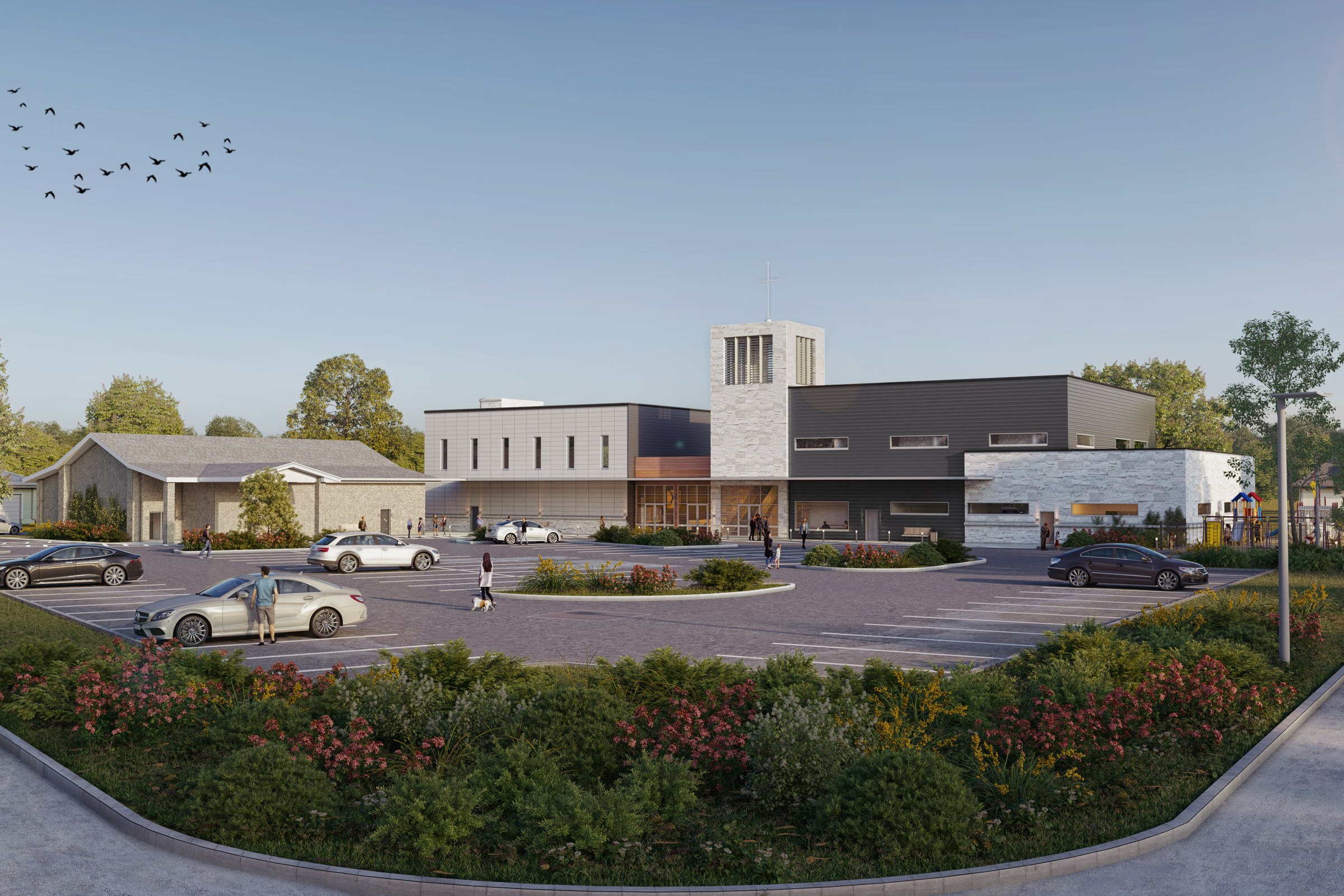
3D rendering of a contemporary church complex featuring a white stone tower, dark metal cladding, and a wood-accented entrance in a landscaped setting.
Project Overview
5 renders. Winnipeg, MB. A institutional project called Project 72 Church Complex that the architecture firm needed visualized before ground broke. That was the starting point.
Large contemporary church complex with white stone tower featuring cross, dark metal cladding, wood-accented entrance canopy.
The Challenge
The project site has strong character — mature trees, sloping terrain, established neighbours. Ignoring that context would have produced renders that felt disconnected from reality. We had to model the environment as carefully as the building itself.
At 5 deliverables, there’s a real risk of redundancy — views that look too similar or don’t add new information. We planned the camera positions deliberately so every image earned its place in the set.
The timeline was compressed. The architecture firm had a launch date that wasn’t moving, which meant our production schedule had zero slack for extended revision cycles.
Our Approach
Lighting development ran parallel to the modelling. We tested multiple Daylight setups early — before the geometry was even finished — so we could lock in the mood and atmosphere without burning production time later.
We leaned on physically-based rendering throughout. Every material — glass, stone, metal, timber — was defined by real-world optical properties. That’s what makes the difference between a render that looks ‘nice’ and one that looks true.
Material selection was hands-on. We sourced textures from manufacturer libraries and matched them against the specification documents. Where specs were ambiguous, we sent samples to the architecture firm for sign-off before rendering.
Camera positions were planned, not improvised. We mapped out eye-level angles based on the project’s strongest design moments, then refined framing through a series of grey-shaded test renders before committing to final production.
The modelling phase was methodical. We built the geometry from the architectural plans, cross-referencing elevations and sections to catch anything that might read differently in three dimensions than it does on paper.
The Result
We delivered the complete package of 5 renders within the agreed 3-4 weeks window. The architecture firm confirmed the images are now central to their sales and approval materials.
Working on something similar? Let’s talk about your project — or browse more of our work.