Aarti Office Cyber Lab
Contemporary Institutional Classroom Visualization
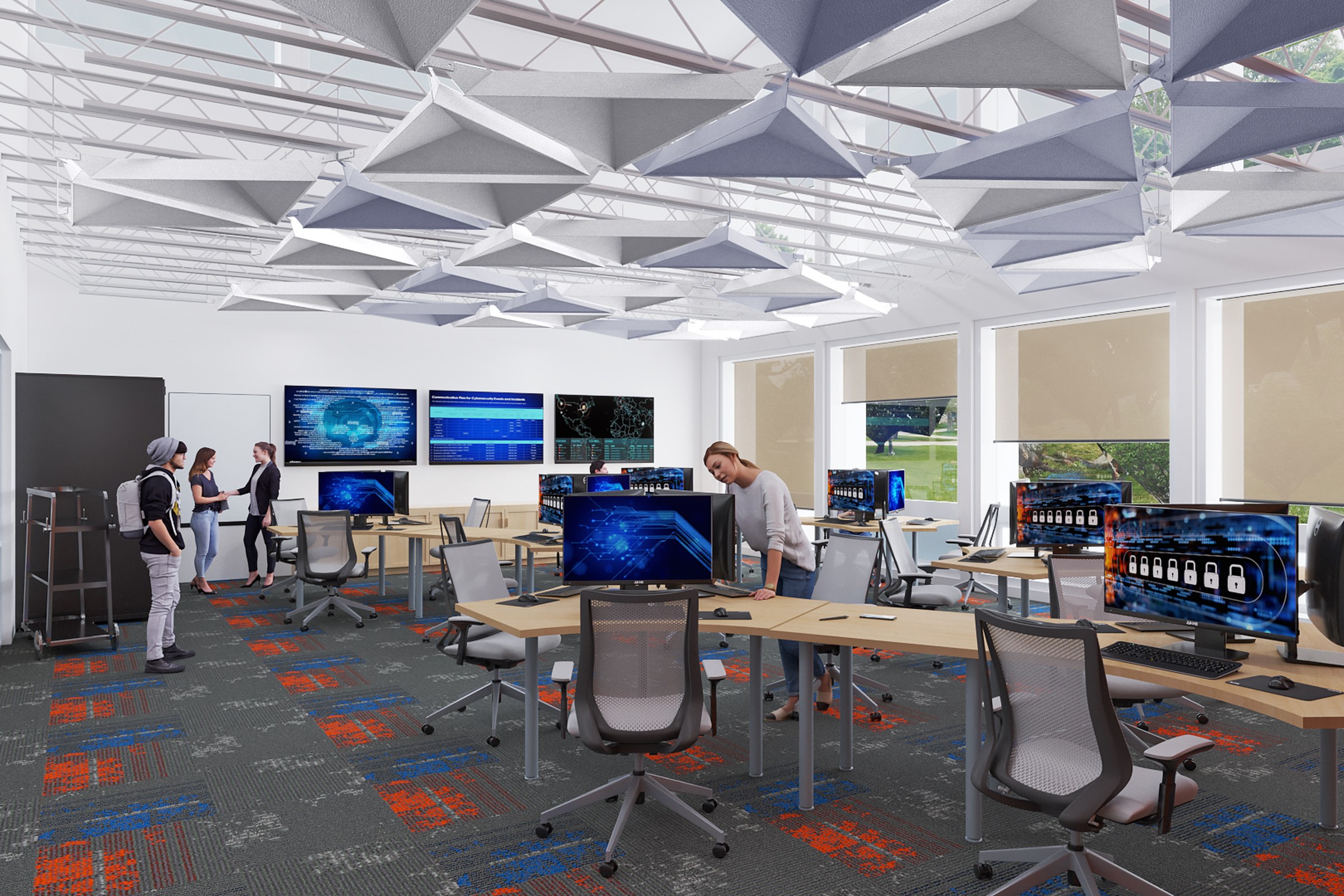
High-tech cyber/computer lab with geometric triangular ceiling panels, skylights, multiple monitor workstations displaying cybersecurity graphics, ergonomic task chairs, and large wall-mounted display screens. Occupied by students/workers.
At 3D Praxis Studio, we had the opportunity to collaborate with Aarti Office Cyber Lab on a project that demanded a sophisticated and modern approach to commercial interiors. The client sought a compelling visualization that would not only showcase their innovative workspace but also serve as a pivotal tool for attracting potential investors and securing planning approvals. With their vision of a cutting-edge office environment, we knew our expertise in architectural visualization would be crucial in bringing their concept to life.
Our approach to this project was centered around creating a photorealistic rendering that highlighted the unique features of the office space. We focused on integrating the latest design trends with the client’s functional requirements, ensuring that every element reflected their brand ethos. By utilizing advanced techniques in lighting and material selection, we crafted an inviting atmosphere that emphasized both aesthetics and functionality. Our team meticulously designed the layout to showcase collaborative spaces, private offices, and breakout areas, ensuring that the flow of the environment was both practical and visually appealing.
For this project, we employed industry-leading software such as Autodesk 3ds Max and V-Ray to achieve stunning realism in our renders. We paid special attention to the lighting, utilizing a combination of natural and artificial sources to create a dynamic ambiance that would resonate with viewers. The materials were carefully selected to reflect the modernity of the space, with textures that added depth and richness to the overall presentation.
The final result was a striking set of visuals that not only met but exceeded the client’s expectations. The high-quality renderings played a crucial role in their marketing strategy, enabling them to effectively pitch to investors and secure the necessary approvals for their project. Our work not only helped Aarti Office Cyber Lab visualize their dream workspace but also positioned them favorably in a competitive market.
Project Overview
For the architecture firm behind Aarti Office Cyber Lab, visualization wasn’t a nice-to-have — it was the centrepiece of their go-to-market strategy. We produced 4 interior views to match that ambition.
High-tech cyber/computer lab with geometric triangular ceiling panels, skylights, multiple monitor workstations displaying cybersecurity graphics, ergonomic task chairs, and large wall-mounted display screens.
The Challenge
The design language was distinctive — a mix of forms and materials that doesn’t photograph itself. Translating that into a render that feels lived-in rather than clinical took several rounds of material and lighting refinement.
Getting the materials right was non-negotiable. The architecture firm had specific finishes in mind, and anything that read as ‘generic CG’ would undermine the credibility of the entire package.
Balancing aesthetics with accuracy is always the tension in this work. The architecture firm wanted images that looked aspirational — but the architects needed every proportion, setback, and material call to be precisely as drawn.
Our Approach
We ran the first round of test renders at reduced resolution to get quick feedback on composition, materials, and overall mood. This let us catch issues early when changes were cheap, not late when they weren’t.
We started where we always start: with the drawings. Every wall thickness, every material notation, every site boundary got translated into the 3D model before we touched a single texture or light.
We shared work-in-progress renders with the architecture firm at two key milestones: after initial composition lock and after material refinement. Both rounds stayed tight — targeted feedback, fast turnarounds.
Camera positions were planned, not improvised. We mapped out eye-level angles based on the project’s strongest design moments, then refined framing through a series of grey-shaded test renders before committing to final production.
Landscape and entourage came last but mattered enormously. Trees, people, vehicles, sky — these contextual elements are what make a render feel like a photograph instead of a diagram.
The Result
Production closed within 2-3 weeks. The hero image is now the signature visual for Aarti Office Cyber Lab, and the supporting gallery views have been deployed across the architecture firm’s marketing channels.
Thinking about visualization for your next project? Reach out — we respond within 24 hours. Or keep exploring.