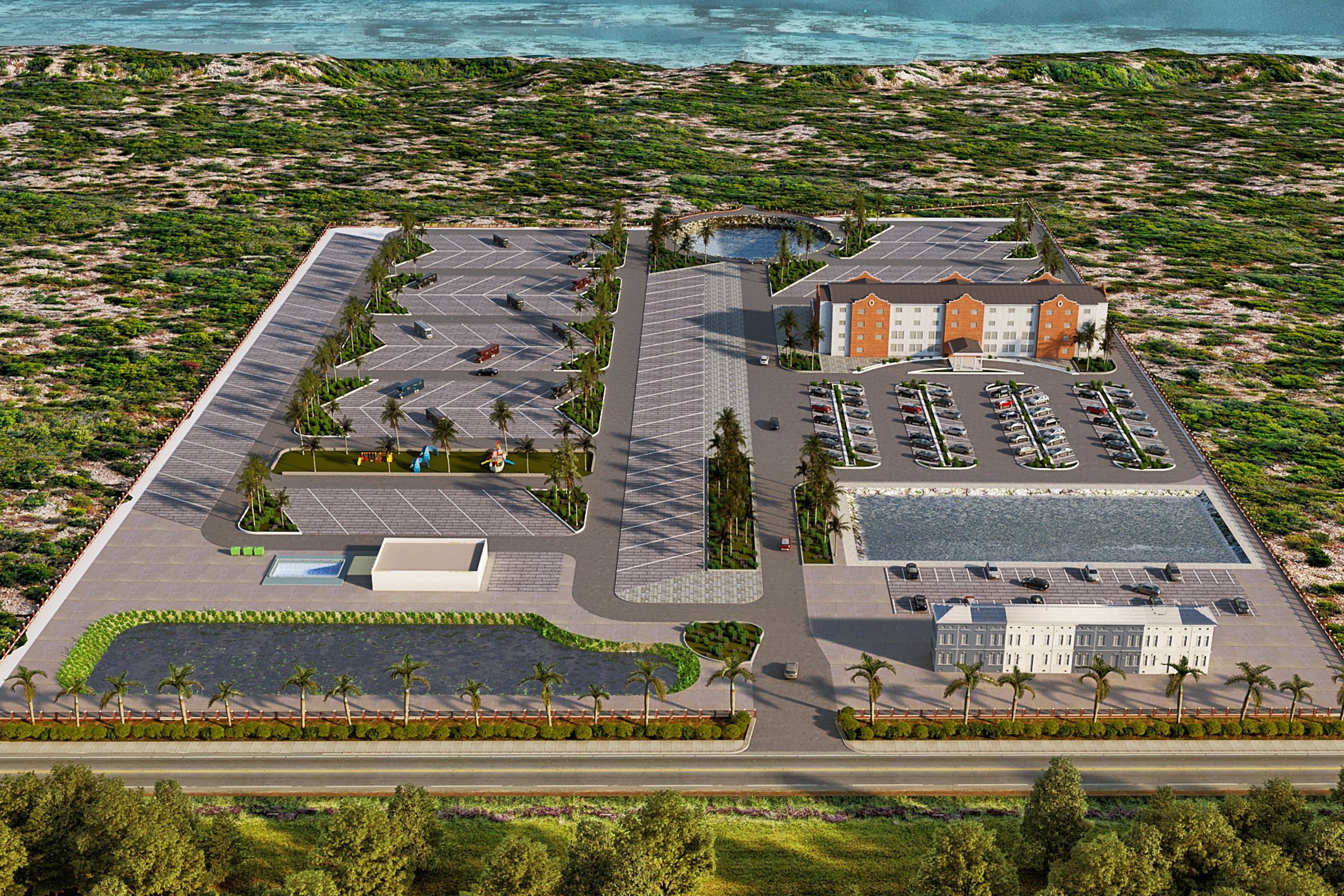
Coastal Commercial Complex — mixed-use 3D rendering by Praxis Studio
Mixed-Use

Coastal Commercial Complex

Modern Commercial Development Visualization

Aerial view of a coastal commercial campus with multiple buildings, large parking areas, palm-lined entry road, and ocean visible in the background.

Project Overview

Sometimes a single image is all it takes to make a design click. That was the brief for Coastal Commercial Complex — one hero render that would carry the weight of the entire presentation.

Aerial view of a coastal commercial campus with multiple buildings, large parking areas, palm-lined entry road, and ocean visible in the background.

The Result

The final output landed within 1-2 weeks. Clean, high-resolution, ready for print and screen. It’s been the visual backbone of this project’s public-facing materials.

Need renders for your own project? Tell us about it — we’d like to hear what you’re working on. Or see more work like this.
Why a Single Aerial Render Carries More Weight Than Expected

An aerial view of a commercial campus is not a landscape painting. It's infrastructure communication dressed in photorealism.

The brief was surgical

The Coastal Commercial Complex specified: 2400 x 1600 px JPEG, daylight lighting. One shot to present a mixed-use masterplan to stakeholders across development, marketing, and investment. No alternate angles. No supplementary materials.

The constraint logic

What most teams underestimate: a single image must compress site plans, elevations, section logic, and environmental context simultaneously. This isn't a convenience. It's a compression problem that shapes every downstream decision about composition, camera height, and material specification.

Why context carries information weight

The palm-lined entry road signals approach hierarchy and landscape integration. The visible coastline anchors the site geographically and justifies the masterplan's spatial orientation.

The weakness in a single masterplan render is that it must work as both technical document and marketing asset. The best ones do both without compromise.

---

What Separates Legible Rendering from Vanity Imagery?

Watch how most aerial masterplans fail at their primary function: helping someone understand actual site layout at a glance.

Focal hierarchy determines legibility

The strongest renders use atmospheric depth and light falloff to push peripheral buildings into soft focus while pulling the primary zone forward. A 2400-pixel width doesn't mean filling every pixel with equal weight.

  • Contrast between sharp foreground and softer background changes navigability drastically
  • Costs minimal render time but completely transforms how the eye reads the frame
  • The Coastal Complex held campus core in focus; surrounding landscape receded appropriately

Why information density collapses

Too many masterplans try to encode phasing, future expansion, and parking strategies into a single aerial. In 2400 pixels, this creates visual noise that prevents stakeholders from extracting any single decision layer.

  • Completed phases vs. future phases require different color callouts
  • Underground parking and above-grade density look identical from height
  • Adding program labels kills legibility faster than removing buildings

---

How Most Aerial Briefs Fail Before Rendering Starts

The fastest way to waste render capacity is to reset the camera height twice during production. A 1-2 week turnaround disappears into 3 weeks.

Precision prevents rework

Gehry + Partners locked down all specifications before first render: one viewpoint, one resolution, JPEG format, daylight only. That clarity made a 1-2 week turnaround possible for an acre-scale visualization.

Parameters that actually move the needle

  • Camera height in meters (120-150m typical for 30-hectare sites)
  • Focal length in mm (28mm vs. 50mm reads completely differently)
  • Solar angle and seasonal light (winter shading differs 90 degrees from summer)
  • Material specificity (photogrammetric detail vs. idealized surfaces)
  • Human and vehicle scale references (determines model complexity downstream)

---

The Technical Reality Beneath the Timeline

Nobody hits 1-2 weeks because rendering hardware is fast. They hit it because the brief is locked and the model is clean.

The view planning bottleneck

A view planning phase that normally consumes 2-3 days determines whether the work flows or stalls. Camera position determines model complexity. Model complexity determines render pass count. Render pass count determines iteration capacity.

  • Every downstream choice cascades from this single decision
  • A locked camera position allows parallel workflows in model prep and lighting
  • Reframing mid-production destroys schedule regardless of hardware horsepower

---

Where This Render Actually Lives

The final image became the public-facing keystone for Coastal Commercial Complex marketing materials. Not a detail study. Not an atmospheric close-up. Complete site at a glance.

That's the actual job of a masterplan render: credible presentation, visually convincing enough that investors take it seriously. The client needed a tool, not reassurance.

---

Other masterplan projects reveal how these constraints shift when you add phasing or scale to 100+ hectares.

Like what you see?

Let's create something extraordinary for your next project.