
Stills or a walkthrough
They are not two qualities of the same deliverable. They answer two different kinds of question — and picking the wrong one is the quietest way a review meeting goes nowhere.
Most practices default to whichever format they already have on hand, not the one the question in front of the board actually needs.
A still is a claim about one decided condition. It fixes the camera, removes movement, and gives everyone in the room the exact same frame to agree or disagree about — which makes it the fastest way to settle a single, specific dispute: does this massing sit right on this street, does this material read at this scale, does the roofline compete with what's already there. That precision is also its limit. It cannot tell you anything about what happens if you keep walking.
A walkthrough is a claim about a sequence. It is the only format that can answer a question about experience over distance or time — does the approach feel safe from the street, does the plaza actually work as you cross it, does scale hold up as a building gets closer instead of staying a fixed size in a frame. Those are real board questions, and no still, however wide or however carefully composed, can carry them.
The two renders below are real work from our own library — not a matched pair of the same scheme, but two genuinely different formats doing two genuinely different jobs.
What each one settles, and what it cannot touch
Read the caption, then the line under it — the one board question this frame is built to answer, and the one it structurally can't.
What a still settles
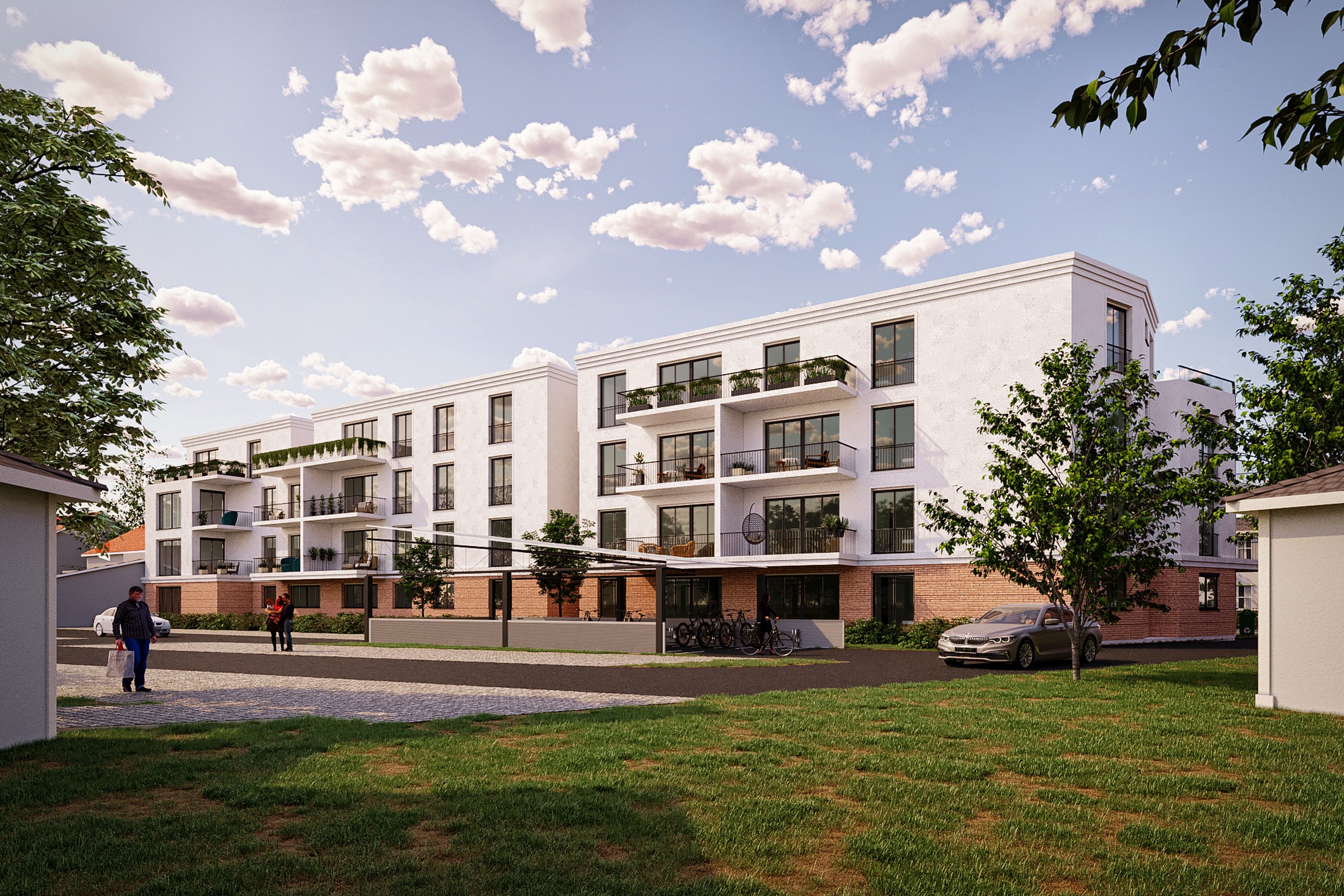
A frontal elevation, nothing moving, everyone in the room looking at the same fixed frame at the same time: a four-storey apartment building, pale render over a brick base, roof planters and balconies at a regular rhythm. That fixed-ness is the whole value. It removes every variable except the one in dispute — does this material read right at this proportion, against this base — and gives a board exactly one thing to agree or disagree about. A still is unbeatable at settling a single decided condition. It has no way to show you what happens if you keep walking.
Where a still runs out
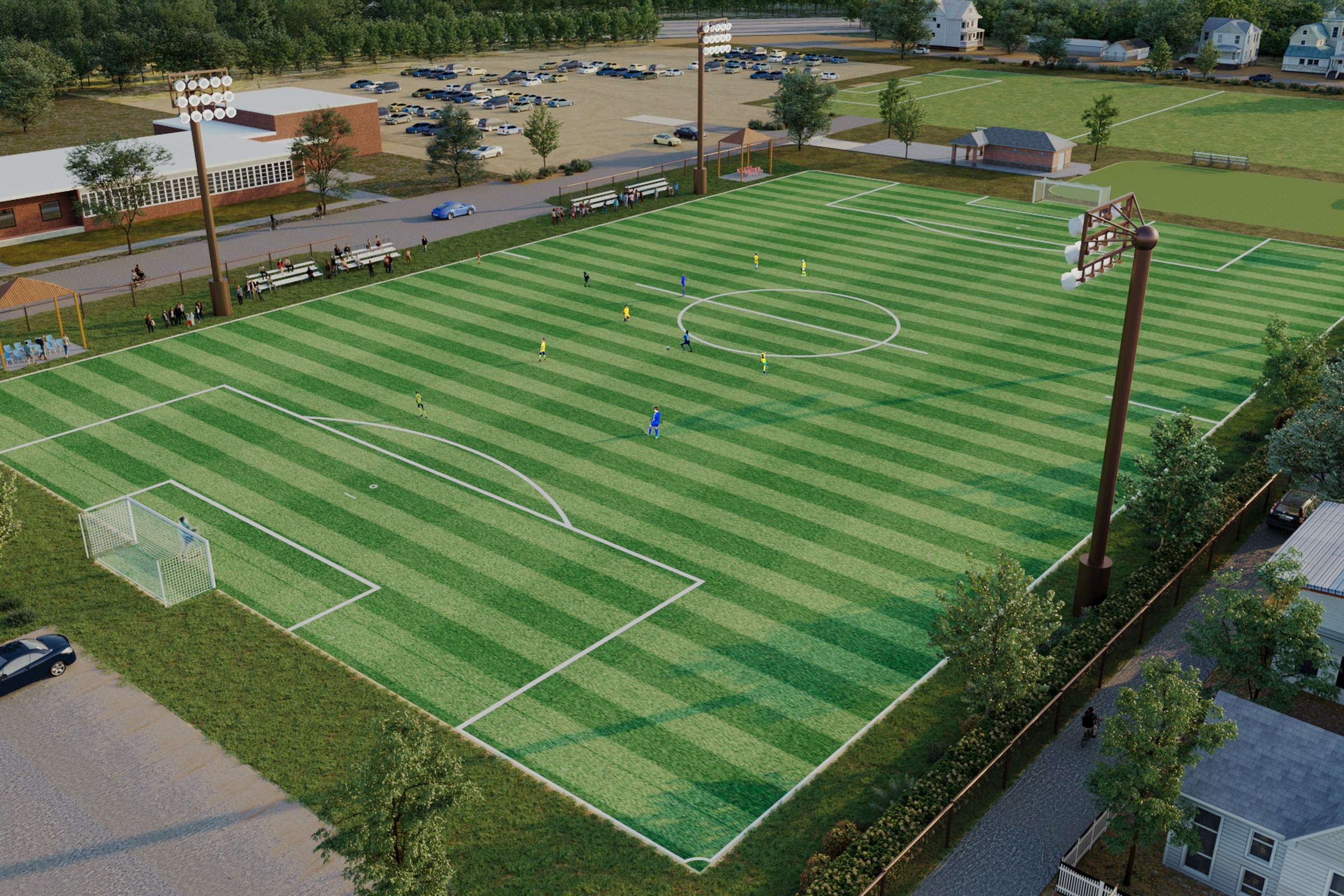
An aerial answers a different order of question — not one material, but how a scheme sits in its site: a full-size field, its floodlights, the fields next to it, the parking that serves them, the houses around the edge, all legible in one frame. That is genuinely something only a wide still (or an orbit at the start of a walkthrough) can give a board — the whole layout, at once, with nothing hidden behind anything else. What it cannot do is answer the question a board almost always asks next: what does it feel like to actually walk from that parking area to the field. That is not a framing problem. It is a different kind of question, and it needs a sequence, not a better angle.
Which format actually answers the question on the table
Not a quality ranking — a still isn't a cheaper walkthrough, and a walkthrough isn't a fancier still. They're built for different questions.
- The debate is one decided condition — a material, a proportion, a roofline against what is already there Send a still. A fixed frame is the fastest way to get a room to agree or disagree about exactly one thing.
- The debate is about experience over distance or time — an approach, a plaza, whether scale holds as you get closer A still cannot carry it however wide you frame it. That question needs a sequence.
A board doesn't remember the format. It remembers whether its question got answered.
We are not showing you a walkthrough here — that would be selling a deliverable, not making the argument. The point of this page is smaller and, we think, more useful: knowing which question you're actually walking into the room with is the cheapest decision in the whole process, and it's usually made by habit rather than on purpose.


