
Nobody designs for a glance
Every decision in a scheme was made slowly. It usually arrives in an inbox as a link that gets three seconds. Four real renders — what a glance reads, and what an actual look finds instead.
A plan gets redrawn a dozen times before anyone renders it. A material gets sampled against real light before it gets specified. A corner gets argued over for a week. None of that shows up in three seconds — it only shows up if someone actually looks. And most of what a render arrives as, in most inboxes, is a link competing with forty other things for a glance. So here is what a glance misses, on four real renders, each looked at properly once.
What a glance reads — and what ninety seconds finds instead
Nothing here needed a better render. It only needed someone to keep looking after the first second.
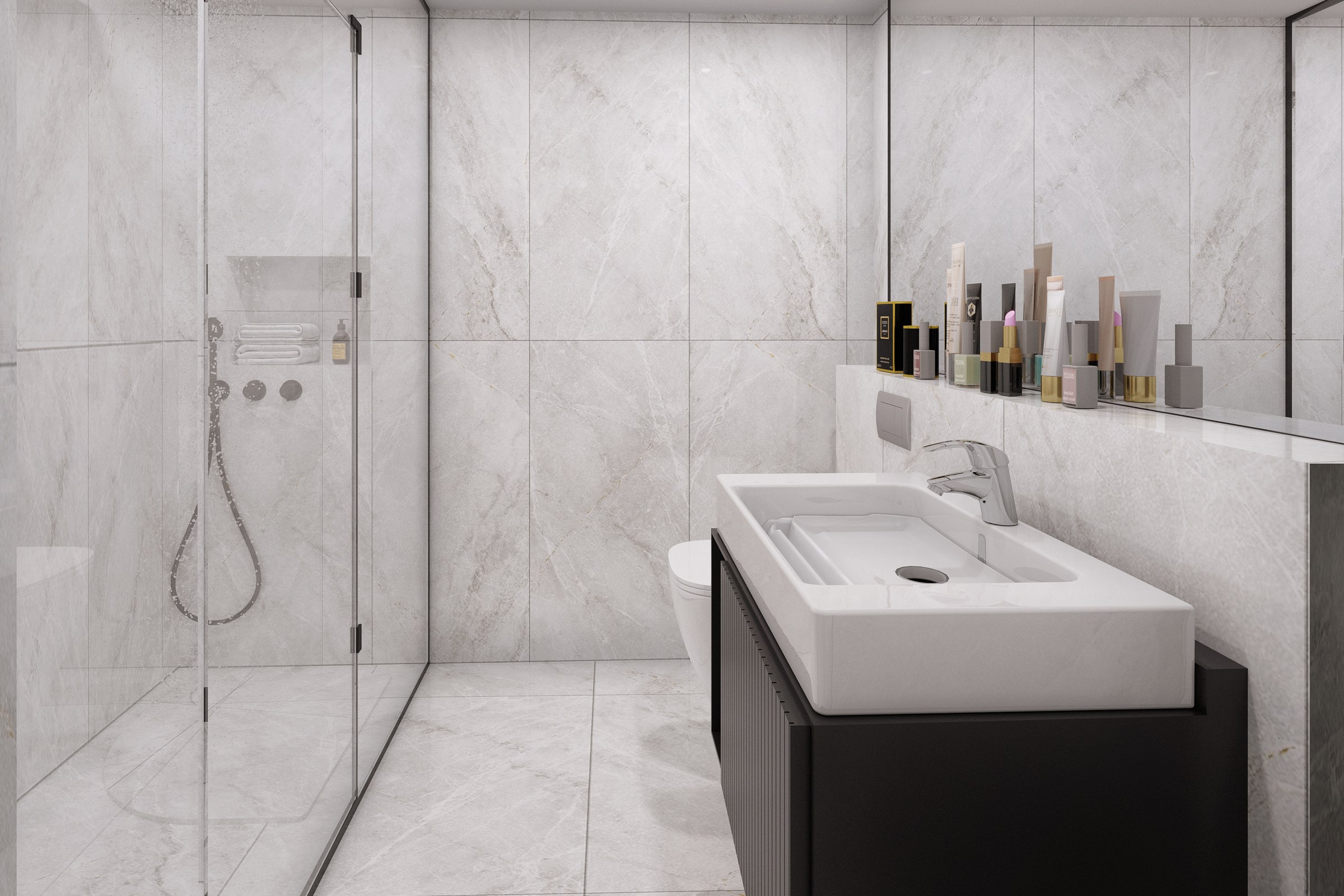
The vein
A glance reads: white marble bathroom.
Look for the full ninety and the veining is not a texture — it is a plan. The grey threads running through the shower wall carry straight across the tile seam onto the panel beside it, and again onto the mirror wall behind the vanity. That continuity does not happen by ordering marble; it happens by someone laying the slabs out on a table first and deciding which face goes next to which, so the room reads as one piece of stone instead of six tiles that happen to match. A glance sees "marble." A look sees the sequencing.
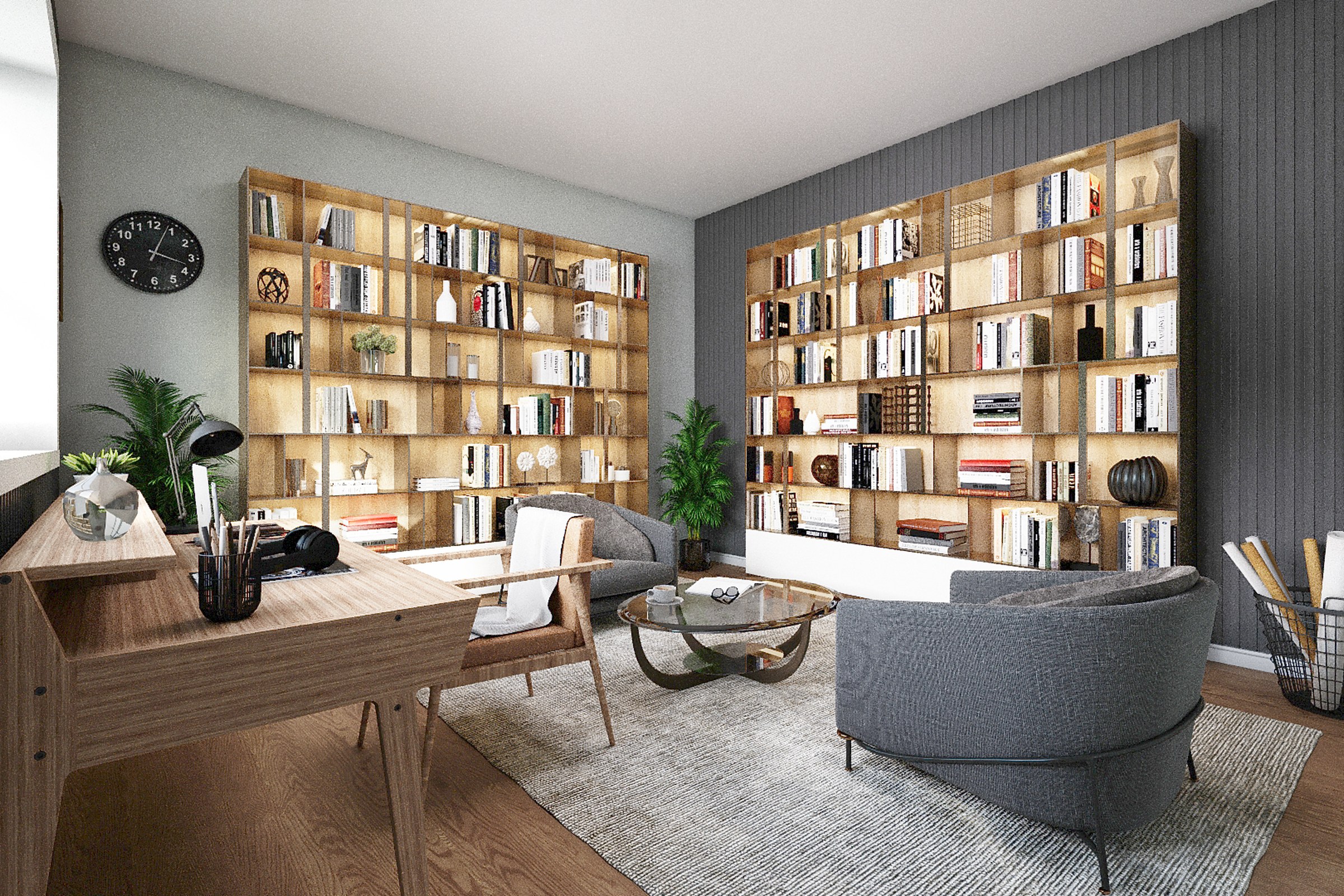
The shelf
A glance reads: a wall of books.
Look longer and it is two separate shelving runs, not one — a deliberate gap breaks the wall in half, and the wall behind each run is a different finish, cool plaster on one side, dark slatted timber on the other. The backlighting is not one strip; it is individually lit bays, on purpose, so the eye lands on the objects rather than the joinery. And the objects are not filler — a globe, a scatter of vases, rolled drawings loose in a wire basket by the desk. A glance sees "storage." A look sees a room somebody actually lives and works in.
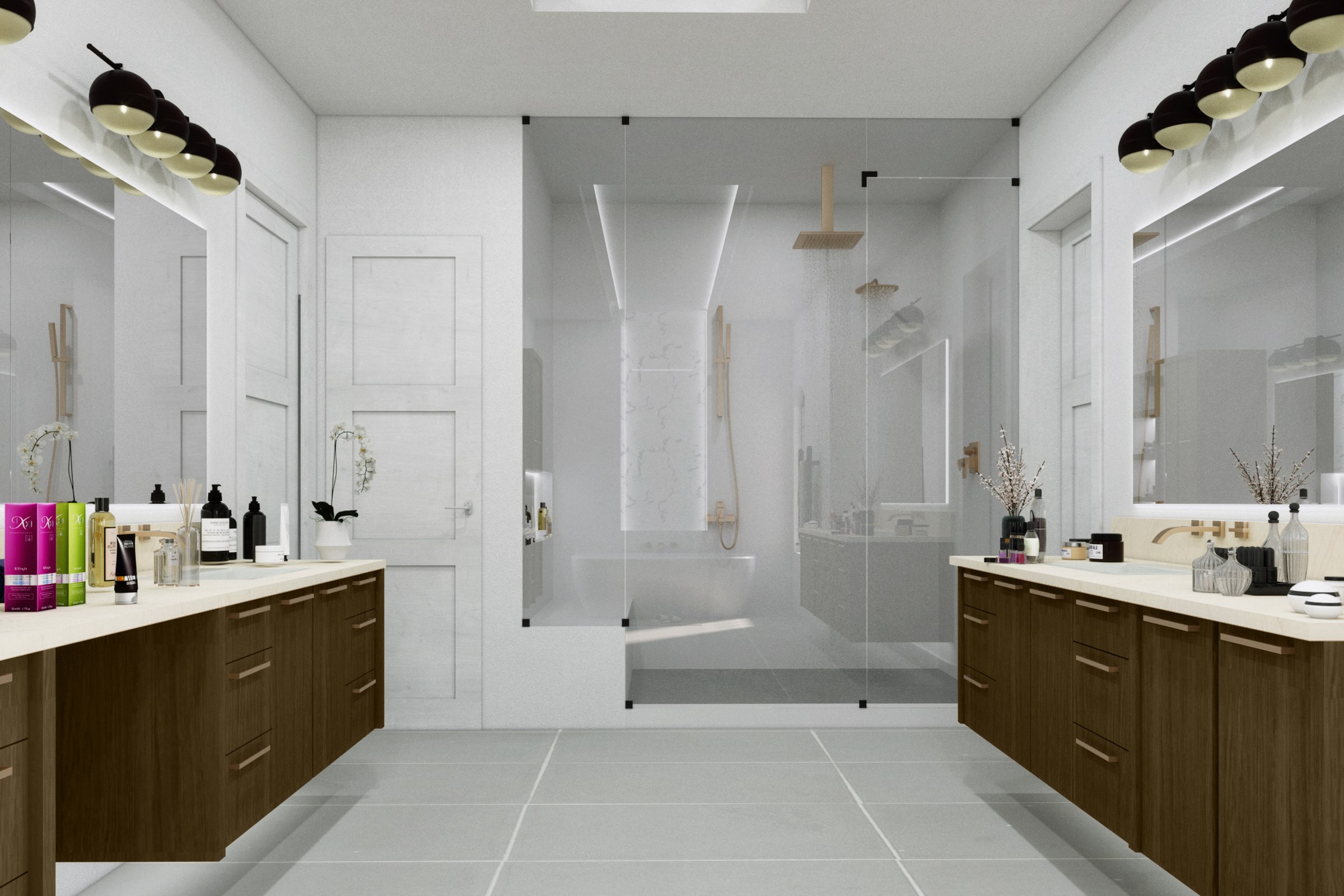
The mirror
A glance reads: his-and-hers, mirrored.
Look again and the symmetry is only in the furniture. The two vanities and their pendant clusters do mirror each other across the room — but the glass-walled wet room between them, holding the tub and the shower in one enclosure, is not a matching pair split down the middle. It is a single volume with one entry, so the "mirrored" bathroom actually has one circulation path, not two. A glance sees a matched set. A look sees the one decision the matching set is built around.
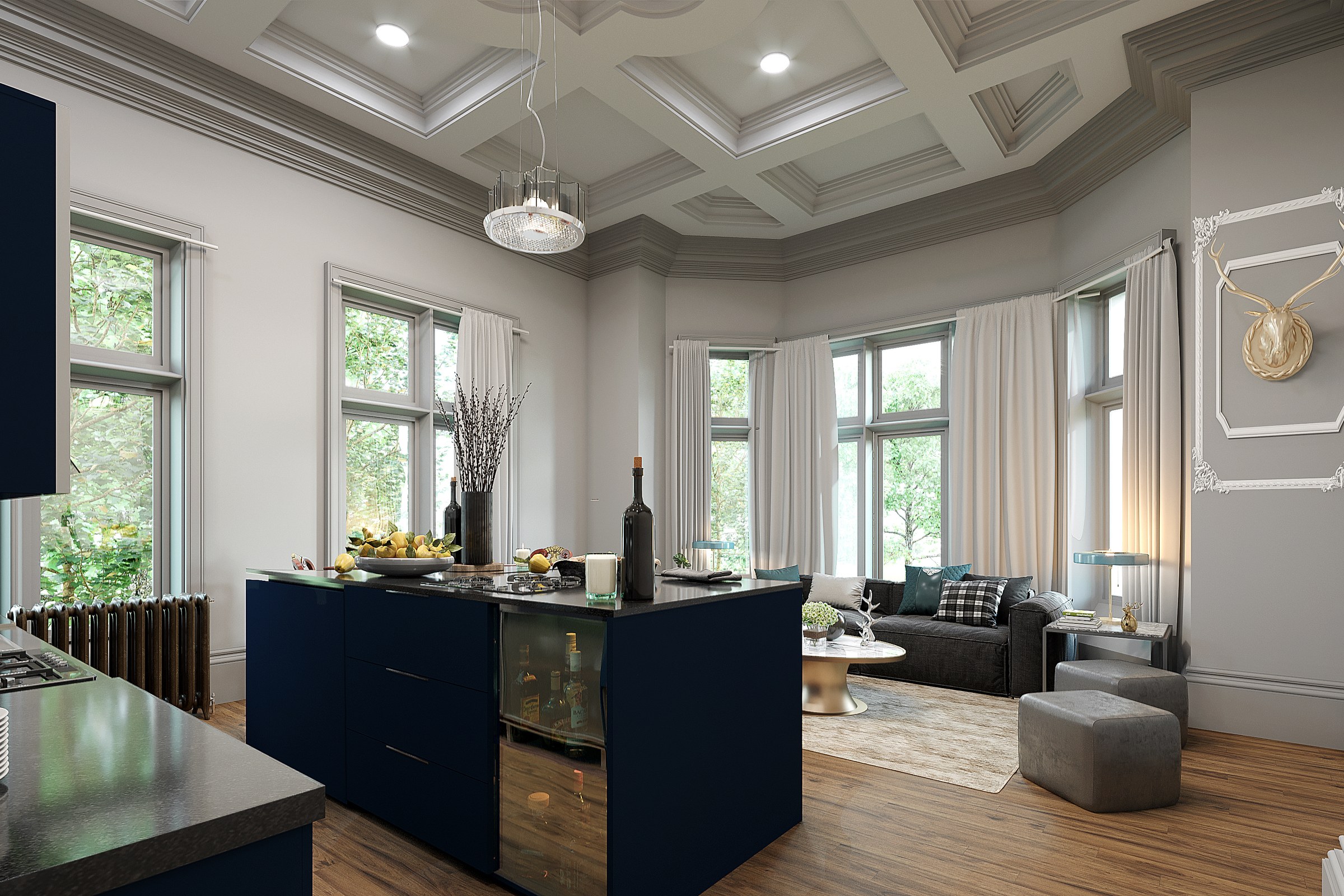
The seam
A glance reads: a kitchen.
Look past the island and there is no wall, no header, no step in the floor telling you where the kitchen ends and the living room begins. The coffered ceiling grid runs unbroken across both. The floorboards run unbroken across both. The only thing marking the change of room is the island itself, turned to face the seating, and what is on the far wall — a framed mount that has no business in a kitchen, which is exactly how you know you have already left it. A glance sees a room. A look sees where a wall used to be, on paper, before someone decided not to build it.
The same file, two different lengths of attention
Every one of the four rooms above follows it. The render doesn't change between the two columns — the amount of time spent on it does.
- At a glance A colour, a material, a room.
- At ninety seconds The sequence, the seam, the decision it cost.
We don't send the link to see if you'll click it. We're starting to send it to see if you'll actually look.
That's the reason a few of our emails, this month, don't have a link in them. We ask first — reply, and we send a short private set worth an honest ninety seconds, not a portfolio to scroll past. It isn't a gate. It's a bet that something you had to ask for gets looked at, and something that just showed up doesn't.


